

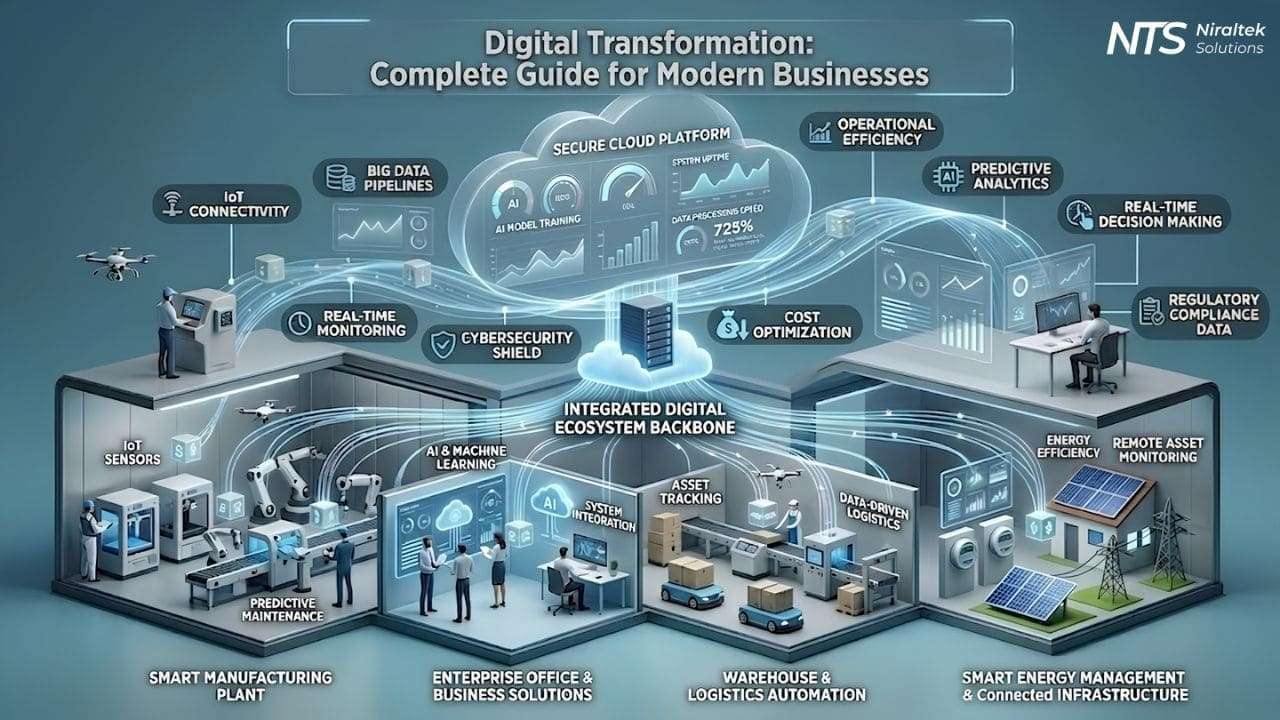
In today’s fast-changing economy, businesses that rely on outdated systems risk falling behind competitors, increasing costs, and slower decision-making. Digital transformation helps organizations modernize operations through intelligent technologies, data-driven insights, and automation. According to McKinsey, companies that successfully implement digital initiatives can significantly improve productivity and accelerate innovation, while Gartner predicts worldwide spending on AI, cloud computing, and intelligent technologies will continue to grow as organizations prioritize automation. A well-defined digital transformation strategy enables businesses to:
- Improve operational efficiency and productivity
- Enhance customer experiences with data-driven decisions
- Reduce costs through automation and process optimization
- Build scalable, future-ready digital transformation solutions
- Strengthen competitiveness with AI, IoT, and cloud technologies
This guide explains how digital transformation in business, consulting services, and the right implementation approach can help organizations achieve sustainable growth.
What is Digital Transformation?
Digital transformation is the process of using digital technologies to improve how a business operates, serves customers, and creates value. Instead of simply replacing paper with digital files, it reshapes workflows, decision-making, and customer experiences through technologies such as AI, IoT, cloud computing, and data analytics.
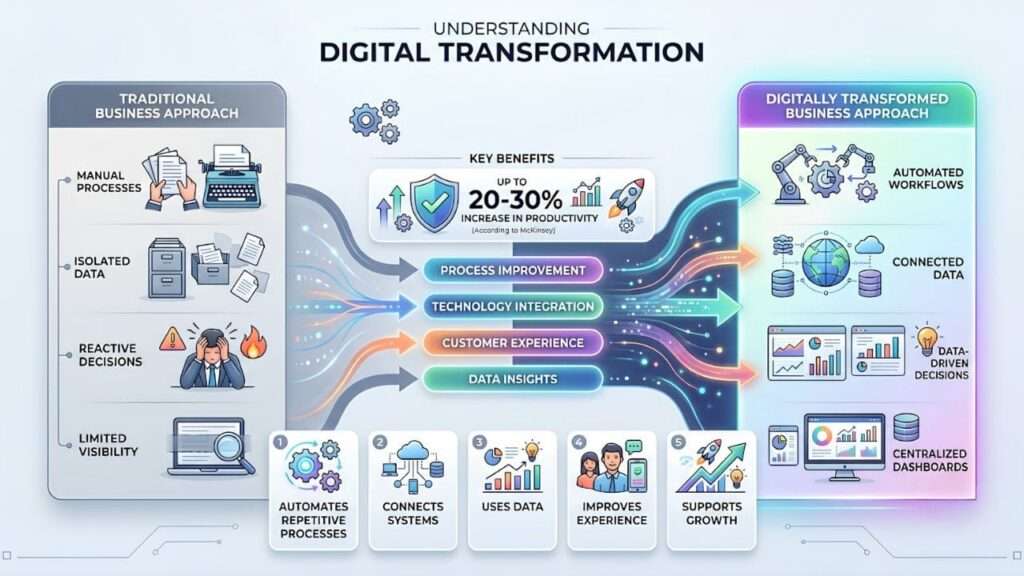
According to McKinsey, organizations that successfully adopt digital technologies can improve productivity by 20–30% while accelerating innovation and business growth.
Key characteristics
- Automates repetitive business processes
- Connects systems for real-time visibility
- Uses data to make faster decisions
- Improves customer and employee experiences
- Supports continuous innovation and scalability
| Traditional Business | Digitally Transformed Business |
| Manual processes | Automated workflows |
| Isolated data | Connected, real-time data |
| Reactive decisions | Data-driven decision-making |
| Limited visibility | Centralized dashboards and analytics |
Why Digital Transformation is Important for Businesses
Today’s customers expect faster services, personalized experiences, and seamless digital interactions. Businesses that rely on outdated systems often struggle with rising costs, slower operations, and limited visibility into their processes. Adopting modern technologies helps organizations overcome these challenges by improving operational efficiency, agility, innovation, and data-driven decision-making.
Key benefits for businesses
- Streamlines operations through automation
- Improves decision-making with real-time data and analytics
- Enhances customer experience across digital channels
- Reduces operational costs and manual errors
- Increases productivity by connecting people, processes, and technology
- Enables businesses to adapt quickly to changing market demands
Businesses that embrace digital technologies today build stronger resilience, improve competitiveness, and prepare for long-term sustainable growth.
Core Technologies Driving Digital Transformation
Successful business solutions rely on advanced technologies that help businesses automate processes, improve decision-making, and increase operational efficiency. Rather than adopting every new tool, organizations should focus on technologies that solve real business challenges and support long-term growth.
Core technologies include:
- Artificial Intelligence (AI): Automates repetitive tasks, predicts trends, and delivers smarter business insights.
- Industrial IoT (IIoT): Connects machines and sensors to monitor assets and operations in real time.
- Cloud Computing: Enables secure data storage, collaboration, and scalable business applications.
- Big Data & Analytics: Converts large volumes of data into actionable insights for better decisions.
- Automation & Robotics: Reduces manual effort, improves productivity, and minimizes operational errors.
- Cybersecurity: Protects digital assets, business data, and connected devices from cyber threats.
Digital Transformation Strategy: A Step-by-Step Approach
A successful modernization strategy aligns technology investments with business goals. Instead of adopting tools without a plan, organizations should follow a structured approach that delivers measurable results and long-term value.
Follow these essential steps:
- Assess current processes: Identify operational bottlenecks and areas that need improvement.
- Define clear objectives: Set measurable goals, such as reducing costs or improving customer satisfaction.
- Choose the right technologies: Select AI, IoT, cloud, or automation solutions that support your objectives.
- Develop an implementation roadmap: Break the project into manageable phases with realistic timelines.
- Train employees: Equip teams with the skills and knowledge to adopt new technologies confidently.
- Monitor performance: Track KPIs and refine your strategy based on business outcomes.
Top Digital Transformation Solutions Across Industries
Every industry faces unique operational challenges, but the right AI, IoT, and automation solutions help organizations improve efficiency, reduce costs, and make smarter decisions. By combining technologies such as AI, IoT, cloud computing, and automation, businesses can streamline workflows and respond quickly to changing market demands.
Popular solutions across industries include:
- Smart Manufacturing: Monitor equipment, automate production, and reduce downtime with Industrial IoT.
- Smart Energy Management: Track energy consumption in real time to improve efficiency and lower utility costs.
- AI Video Analytics: Enhance workplace safety, security, and operational monitoring with intelligent video insights.
- Predictive Maintenance: Identify equipment issues before failures occur to minimize unplanned downtime.
- Remote Asset Monitoring: Monitor machines and field assets from a centralized dashboard across multiple locations.
- Warehouse & Logistics Automation: Optimize inventory management, route planning, and shipment tracking.
Digital Transformation Services Offered by Solution Providers
Technology consulting and implementation services help businesses modernize operations, improve efficiency, and accelerate innovation through the right mix of technology and expertise. Instead of offering a one-size-fits-all solution, experienced providers assess business needs and deliver customized solutions that support long-term growth.
Common services include:
- Digital Strategy Consulting: Create a roadmap aligned with business goals.
- Industrial IoT Solutions: Connect machines and assets for real-time monitoring and control.
- AI & Machine Learning: Automate repetitive tasks and generate actionable business insights.
- Cloud Migration: Move applications and data to secure, scalable cloud platforms.
- Custom Software Development: Build applications tailored to specific operational requirements.
- Data Analytics & Dashboards: Transform business data into meaningful reports and real-time insights.
- System Integration: Connect ERP, CRM, and operational systems for seamless information flow.
How to Choose the Right Digital Transformation Company
Choosing the right technology partner plays a critical role in the success of your modernization journey. The ideal partner understands your business goals, recommends practical solutions, and supports implementation from planning to deployment. Rather than selecting a provider based only on cost, evaluate their expertise, industry experience, and long-term support capabilities.
Consider these key factors:
- Industry experience: Look for successful projects in your sector.
- Technical expertise: Ensure the team has experience with AI, IoT, cloud computing, and automation.
- Customized solutions: Choose a partner that tailors solutions to your business needs.
- End-to-end support: Verify they provide consulting, implementation, training, and ongoing maintenance.
- Proven results: Review case studies, client testimonials, and measurable business outcomes.
Future of Digital Transformation & Why Businesses Should Act Now
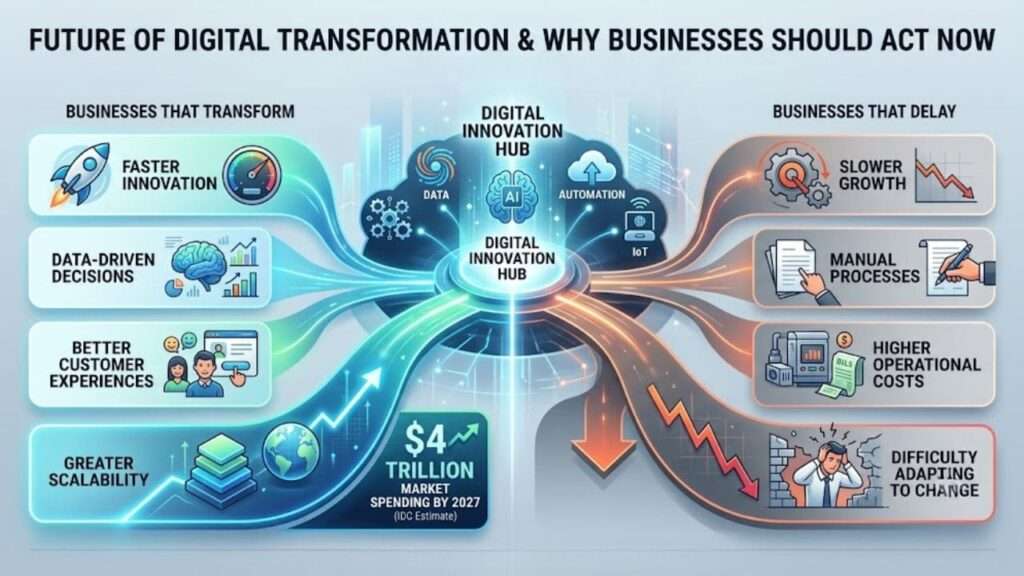
The future of business innovation will be shaped by AI, Industrial IoT, cloud computing, edge analytics, and intelligent automation. Businesses that invest in these technologies today can improve efficiency, respond faster to market changes, and deliver better customer experiences. According to IDC, global spending on AI, cloud technologies, and intelligent business solutions is expected to reach nearly $4 trillion by 2027, highlighting the growing adoption of modern technologies across industries.
Why businesses should act now
- Increase operational efficiency through automation.
- Make faster decisions with real-time data.
- Strengthen cybersecurity and business resilience.
- Improve customer satisfaction with personalized digital experiences.
- Stay competitive in a rapidly evolving market.
| Businesses That Transform | Businesses That Delay |
| Faster innovation | Slower growth |
| Data-driven decisions | Manual processes |
| Better customer experiences | Higher operational costs |
| Greater scalability | Difficulty adapting to change |
Ready to accelerate your digital transformation journey? Partner with Niraltek Solutions to implement AI, Industrial IoT, and automation solutions that improve efficiency and drive business growth. Contact us today to get started.
Conclusion
Modern businesses need connected technologies, automation, and data-driven decisions to stay competitive. By adopting the right technologies, building a clear strategy, and partnering with experienced experts, organizations can streamline operations, make data-driven decisions, and achieve sustainable growth. Whether you’re starting your transformation journey or expanding existing initiatives, the right approach can unlock long-term business value. If you’re ready to modernize your operations with AI, Industrial IoT, and automation, Niraltek Solutions can help you build a smarter, future-ready enterprise.
Frequently Asked Questions (FAQs)
1. What does digital transformation mean?
It is the process of using technologies such as AI, Industrial IoT, cloud computing, and automation to improve business operations, enhance customer experiences, and support long-term growth.
2. Why should businesses invest in modern digital technologies?
Modern technologies help organizations automate repetitive tasks, reduce operational costs, improve productivity, and make faster decisions using real-time data.
3. Which industries benefit the most from business modernization?
Manufacturing, healthcare, logistics, retail, energy, agriculture, finance, and smart buildings can improve efficiency, automation, and decision-making by adopting modern technologies.
4. What technologies are commonly used?
Organizations typically implement Artificial Intelligence (AI), Industrial IoT (IIoT), cloud computing, big data analytics, cybersecurity, edge computing, and automation to streamline operations and improve performance.
5. How do businesses begin their modernization journey?
Start by evaluating existing processes, defining business goals, identifying technology gaps, creating a clear roadmap, and implementing solutions in phases while tracking measurable outcomes.
6. What challenges do organizations face during implementation?
Common challenges include legacy systems, employee resistance to change, data security concerns, budget limitations, and integrating new technologies with existing infrastructure.
7. How can the right technology partner support business growth?
A trusted technology partner evaluates business needs, recommends suitable solutions, manages implementation, provides employee training, and delivers ongoing support to maximize long-term value.
8. How can Niraltek Solutions help businesses?
Niraltek Solutions provides AI, Industrial IoT, cloud, and automation solutions that help organizations improve operational efficiency, gain real-time visibility, reduce costs, and achieve sustainable business growth.