

Client Overview
Client: Bigfoot Cold Storage
Industry: Cold Chain & Storage
Location: Vadakarai, Grant Lyon, Red Hills, Chennai, Alinjivakkam, Tamil Nadu 600052
Solution Deployed: Temperature Monitoring System, Humidity Monitoring System, Hazardous Gas Monitoring System, Smart Energy Monitoring (SEM), NTS IoT Gateway & LoRa Wireless Monitoring
Overview
Bigfoot Cold Storage specializes in storing temperature-sensitive and perishable products in controlled cold storage environments. The facility maintains storage temperatures between 7°C and 14°C, making continuous temperature and humidity monitoring essential for preserving product quality, reducing spoilage, and optimizing energy consumption.
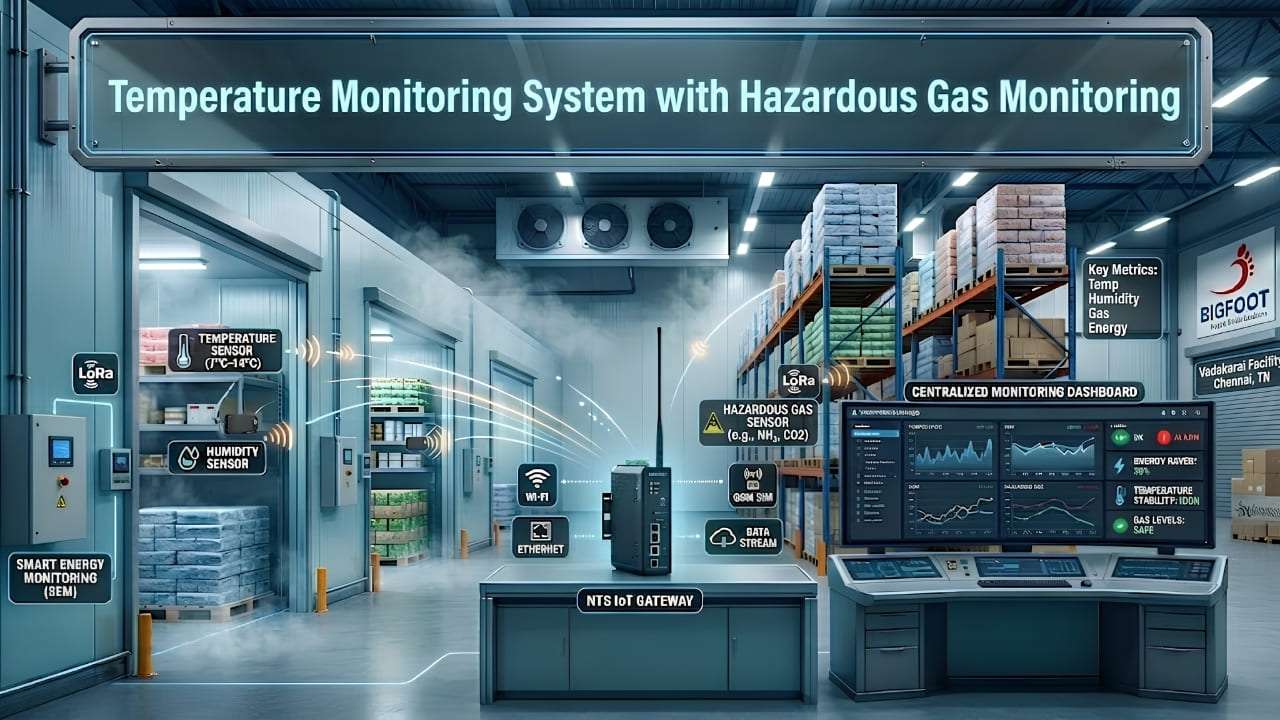
To modernize cold storage operations, Bigfoot Cold Storage partnered with Niraltek to implement an intelligent Temperature Monitoring System integrated with Humidity Monitoring, Hazardous Gas Monitoring, Smart Energy Monitoring (SEM), and the NTS IoT Gateway. The gateway acts as the central communication hub, supporting Wi-Fi, Ethernet, and GSM SIM connectivity for reliable data transmission. Combined with LoRa-based wireless sensors, the Temperature Monitoring System provides real-time monitoring, centralized visibility, and proactive management of critical cold storage parameters.
Business Objective
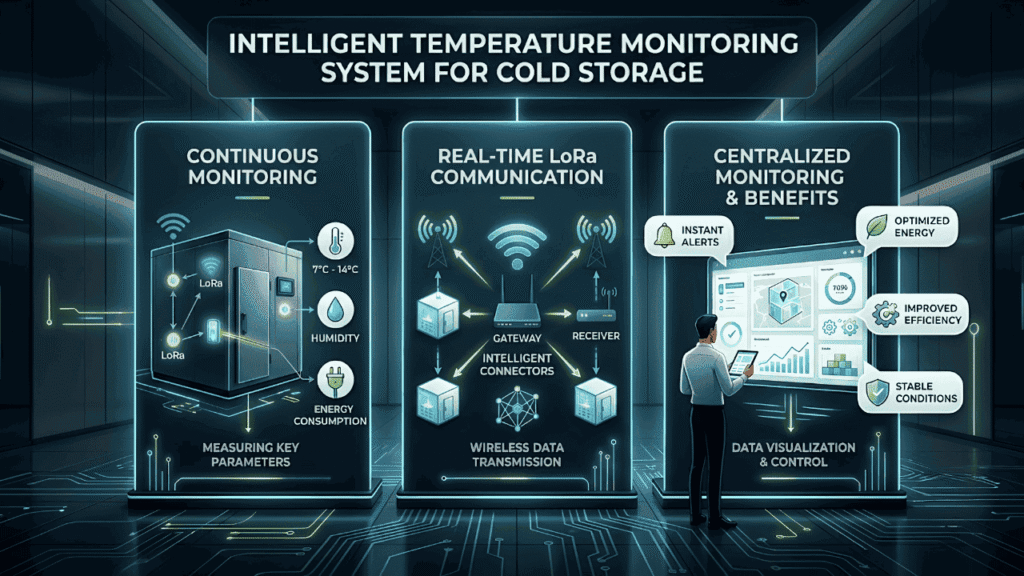
The objective was to implement an intelligent Temperature Monitoring System for cold storage capable of continuously monitoring the 7°C–14°C storage temperature range, humidity, hazardous gas levels, and energy consumption across multiple cold storage chambers. The solution was designed to improve refrigeration efficiency, optimize energy usage, reduce manual monitoring, and maintain ideal storage conditions for temperature-sensitive products.
The implementation focused on:
- Continuous temperature monitoring
- Real-time humidity monitoring
- Smart energy monitoring
- Hazardous gas monitoring
- Stable cold room conditions
- LoRa wireless communication
- Centralized monitoring
- Instant alerts and notifications
- Improved operational efficiency
Business Challenges
Before implementing the solution, Bigfoot Cold Storage faced several operational challenges that affected refrigeration efficiency and product quality. The absence of an automated Temperature Monitoring System made it difficult to maintain stable storage conditions and respond quickly to environmental changes.
Temperature Fluctuations
Maintaining consistent temperatures across multiple cold storage chambers was difficult, increasing the risk of product spoilage.
Humidity Control
The absence of continuous humidity monitoring made it challenging to maintain ideal storage conditions for perishable products.
Hazardous Gas Safety
Cold storage facilities lacked continuous monitoring of hazardous gas concentrations, increasing safety risks for personnel and delaying the detection of potentially dangerous conditions.
Rising Energy Consumption
Continuous refrigeration operations resulted in increasing electricity costs and reduced overall energy efficiency.
Manual Monitoring
Temperature and humidity were monitored manually, delaying the detection of abnormal conditions and corrective actions.
Limited Operational Visibility
Operators lacked centralized, real-time visibility into environmental conditions and refrigeration system performance.
Proposed Solution
Niraltek implemented an integrated Temperature Monitoring System designed specifically for cold chain applications. The Temperature Monitoring System continuously captures environmental data, enabling real-time monitoring, automated alerts, and centralized control.
The deployed solution included:
- Temperature Monitoring System
- Humidity Monitoring System
- Hazardous Gas Monitoring System
- Smart Energy Monitoring (SEM)
- NTS IoT Gateway
- Sensor Nodes
- LoRa Wireless Communication
- Master Gateway with Wi-Fi, Ethernet & GSM SIM Connectivity
- Centralized Monitoring Dashboard
- Real-Time Alerts & Notifications
- Historical Data Analysis
The solution continuously monitors temperature, humidity, and hazardous gas levels across two cold storage chambers using dedicated Sensor Nodes (Slave Devices) connected to industrial-grade sensors.. The collected data is transmitted wirelessly to the NTS IoT Gateway (Master Gateway), which supports Wi-Fi, Ethernet, and GSM SIM connectivity for reliable communication with the centralized monitoring platform. This enables real-time visualization, instant alerts, historical reporting, and improved operational control.
Solution Architecture
The solution is built on a scalable Industrial IoT architecture that integrates the Temperature Monitoring System and Hazardous Gas Monitoring System with LoRa wireless communication and the NTS IoT Gateway for secure and reliable data transmission.
NTS IoT Gateway (Master Gateway)
The NTS IoT Gateway acts as the master device of the monitoring system, receiving data from slave devices through LoRa wireless communication and securely transmitting it to the cloud platform. Supporting Wi-Fi, Ethernet, and GSM SIM connectivity, it provides reliable communication even in industrial environments where network availability may vary.
Sensor Nodes ( Slave Devices)
Each cold storage chamber is equipped with a dedicated Sensor Node (Slave Device) that collects temperature, humidity, and hazardous gas data from connected industrial sensors before transmitting it to the NTS IoT Gateway via LoRa communication.
LoRa Wireless Communication
LoRa technology provides reliable long-range wireless communication between the Sensor Node and the NTS IoT Gateway, reducing wiring complexity while ensuring stable data transmission throughout the facility.
Temperature & Humidity Sensors
Industrial-grade sensors continuously monitor environmental conditions inside each chamber, ensuring stable temperature and humidity levels for safe product storage.
Central Monitoring Platform
The centralized monitoring dashboard provides real-time visualization of temperature, humidity, hazardous gas levels, energy consumption, historical trends, and alarm notifications, enabling operators to monitor all critical parameters from a single interface.
Hazardous Gas Sensors
Industrial hazardous gas sensors continuously monitor gas concentrations inside the cold storage facility. When abnormal gas levels are detected, the system immediately generates alerts and notifications, helping improve worker safety and enabling rapid corrective action.
Key Solution Capabilities
- Real-Time Temperature Monitoring
- Temperature & Humidity Monitoring
- Hazardous Gas Monitoring
- Cold Storage Temperature Monitoring
- Warehouse Temperature Monitoring
- Smart Energy Monitoring
- Wireless Temperature Monitoring using LoRa
- Remote Temperature Monitoring
- Automated Alerts & Notifications
- Historical Data Analysis
- Centralized Dashboard
Implementation
The implementation was completed with minimal disruption to daily cold storage operations.
Phase 1 – Site Assessment
Evaluation of refrigeration equipment, storage chambers, monitoring requirements, and energy consumption patterns.
Phase 2 – Device Installation
Deployment of temperature, humidity, hazardous gas sensors, Slave Devices, LoRa communication modules, Smart Energy Monitoring devices, and the NTS IoT Gateway across the facility.
Phase 3 – Platform Integration
Integration of field devices with the centralized monitoring platform, including dashboard configuration, alerts, historical reporting, and data visualization.
Phase 4 – Performance Optimization
Continuous monitoring and optimization of refrigeration performance using real-time operational data and intelligent analytics.
Business Outcomes
Following the successful implementation of the Temperature Monitoring System, Bigfoot Cold Storage achieved measurable improvements in operational performance.
Key Outcomes
- 30% reduction in energy consumption
- Improved temperature stability across cold storage chambers
- Maintained a stable storage temperature range of 7°C–14°C
- Improved worker safety through continuous hazardous gas monitoring
- Faster detection of abnormal gas conditions
- Better humidity control for temperature-sensitive products
- Reduced operational costs
- Enhanced refrigeration efficiency
- Faster identification of abnormal operating conditions
- Centralized monitoring and reporting
- Reduced dependency on manual monitoring
Before vs After
| Before | After |
| Manual temperature & humidity monitoring | Automated real-time monitoring |
| High energy consumption | Optimized energy usage |
| Inconsistent storage conditions | Stable temperature & humidity control |
| Delayed issue detection | Instant alerts & faster response |
| Limited operational visibility | Centralized live monitoring dashboard |
Key Business Benefits
- Improved cold storage efficiency
- Better product quality and safety
- Enhanced workplace safety through hazardous gas monitoring
- Optimized energy consumption
- Continuous temperature and humidity monitoring
- Reliable LoRa wireless communication
- Secure data transmission through the NTS IoT Gateway
- Faster maintenance response
- Remote monitoring capability
- Improved operational visibility
- Lower operational costs
Conclusion
Niraltek’s Temperature Monitoring System enabled Bigfoot Cold Storage to modernize its cold storage operations through intelligent environmental monitoring and energy management. The Temperature Monitoring System delivers reliable real-time monitoring, centralized visibility, and proactive alerts, ensuring optimal storage conditions while improving operational efficiency. By combining Temperature and Humidity Monitoring, Hazardous Gas Monitoring, Smart Energy Monitoring, LoRa wireless communication, and the NTS IoT Gateway with Wi-Fi, Ethernet, and GSM SIM connectivity, the solution delivers reliable real-time monitoring, centralized operational visibility, and proactive alerts. The implementation ensures stable cold storage conditions, reduces energy consumption, protects product quality, minimizes manual intervention, and provides complete operational visibility through real-time monitoring and intelligent Industrial IoT technology.