

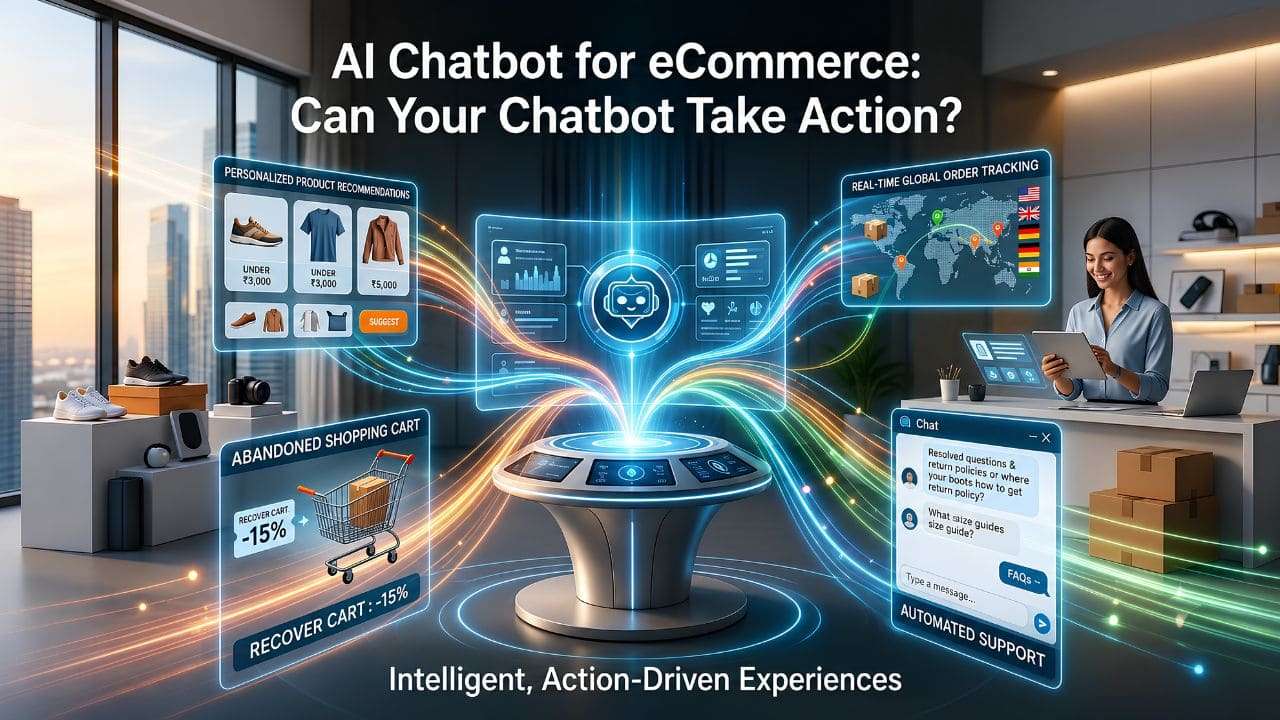
Today’s online shoppers expect more than instant answers-they expect intelligent, action-driven experiences. While traditional chatbots simply respond to customer queries, an AI Chatbot for eCommerce can take meaningful actions, such as recommending products, recovering abandoned carts, tracking orders, and automating customer support. According to Salesforce, 39% of consumers already use AI for product discovery, while 75% of retailers believe AI agents will be essential to staying competitive. By combining Generative AI for eCommerce with intelligent automation, businesses can transform customer conversations into real business outcomes, improve shopping experiences, increase conversions, and build long-term customer loyalty.
Key Highlights
- Deliver 24/7 automated customer support with instant responses.
- Recommend products based on customer preferences and shopping behavior.
- Recover abandoned carts through personalized follow-ups.
- Track orders and automate post-purchase support.
- Automate repetitive customer service tasks and improve efficiency.
- Increase customer satisfaction, retention, and conversion rates.
What Is an AI Chatbot for eCommerce?
An AI Chatbot for eCommerce is an intelligent virtual assistant that interacts with customers in real time using Artificial Intelligence (AI), Natural Language Processing (NLP), and Generative AI. Unlike traditional rule-based chatbots, an AI Chatbot for eCommerce understands customer intent, provides personalized product recommendations, answer complex questions, track orders, and even recover abandoned carts. According to IBM, 85% of retail and eCommerce businesses have implemented chatbots to improve customer experience and streamline operations. Additionally, Salesforce reports that 39% of consumers already use AI for product discovery, highlighting the growing role of AI in online shopping.
Key Capabilities of an AI Chatbot for eCommerce
- Provides 24/7 instant customer support.
- Recommends products based on customer preferences.
- Tracks orders and delivery status in real time.
- Answers FAQs and resolves common customer queries.
- Reduces cart abandonment with personalized assistance.
- Supports multiple languages for global customers.
Example Use Cases
| Customer Query | AI Chatbot Response |
| I’m looking for running shoes under ₹5,000. | Recommends matching products based on budget and preferences. |
| Where is my order? | Instantly shares real-time order and delivery status. |
| Do you have this product in blue? | Checks inventory and suggests available color options. |
| Can I return this item? | Explains the return policy and initiates the return process if eligible. |
How AI Chatbots Drive Action Across the Customer Journey
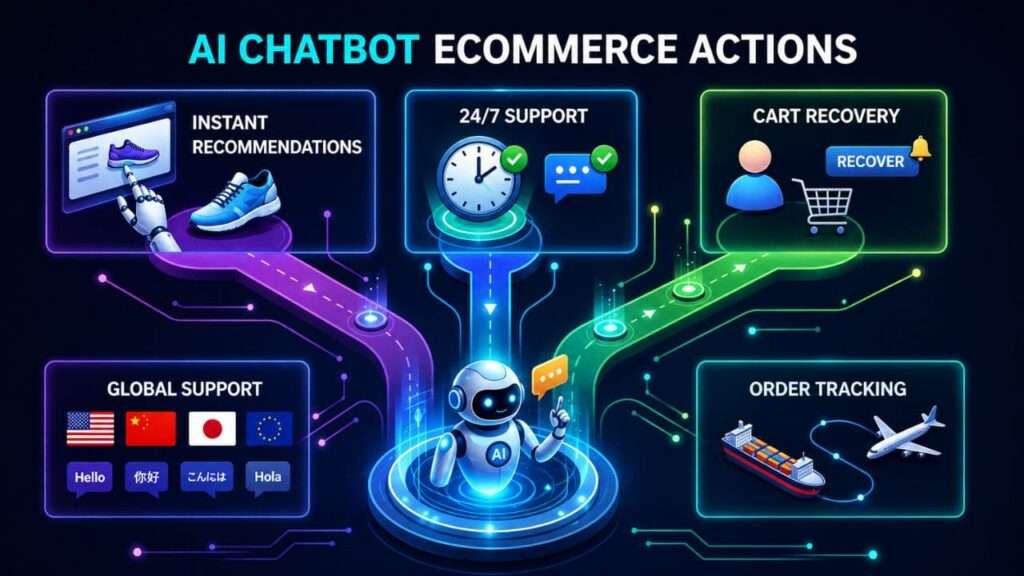
AI Chatbots for eCommerce are transforming eCommerce by taking intelligent actions that make online shopping faster, smarter, and more personalized. Instead of waiting for a customer support agent, shoppers receive instant answers, tailored product recommendations, and real-time assistance throughout their buying journey. From answering pre-purchase questions to resolving post-purchase issues, AI Chatbots for eCommerce improve customer experiences while helping businesses increase efficiency and sales.
How AI Chatbots Take Action
- Recommend the Right Products Instantly : Suggest products based on browsing history and customer preferences.
- Answer Customer Questions in Real Time : Resolve common queries like product availability, pricing, and return policies 24/7.
- Recover Abandoned Carts Automatically : Send timely reminders or exclusive discounts to encourage customers to complete abandoned purchases.
- Real-Time Order Tracking: Share live shipping updates without requiring customers to contact support.
- Support Global Customers in Multiple Languages : Communicate with customers in multiple languages, making global shopping more convenient.
Key Features of an AI Chatbot for eCommerce
An AI Chatbot for eCommerce doesn’t just answer questions—it performs real business actions. From recommending products and tracking orders to automating customer support, these intelligent features help businesses AI Chatbots for eCommerce deliver faster, smarter, and more personalized shopping experiences.
Key Features
- Natural Language Processing (NLP): Understands customer questions and responds naturally.
- Personalized Product Recommendations: Suggests products based on browsing history, purchase behavior, and preferences.
- 24/7 Instant Customer Support: Answers common questions about products, payments, shipping, and returns at any time.
- Real-Time Order Tracking: Provides live order status and delivery updates without requiring manual support.
- Multilingual Communication: Supports multiple languages to serve customers across different regions.
- Seamless Platform Integration: Connects with platforms like Shopify, WooCommerce, Magento, and CRM systems for a unified customer experience.
AI Chatbot vs AI Assistant vs AI Agent
Although people often use these terms interchangeably, AI Chatbots, AI Assistants, and AI Agents serve different purposes in eCommerce. Understanding these differences helps businesses choose the right solution for customer engagement and business automation.
Key Differences
- AI Chatbot: Answers customer questions while recommending products, tracking orders, and automating common customer interactions.
- AI Assistant: Offers personalized shopping guidance by remembering customer preferences and purchase history.
- AI Agent: Goes beyond conversations by making decisions and completing tasks automatically.
| Feature | AI Chatbot | AI Assistant | AI Agent |
| Primary Role | Answer questions | Personalize shopping | Automate business tasks |
| Interaction | Conversational | Personalized guidance | Autonomous decision-making |
| Best For | Customer support | Shopping assistance | End-to-end workflow automation |
Unlike traditional chatbots that mainly respond to queries, modern AI-powered chatbots and AI agents can perform actions such as updating orders, processing returns, recommending products, and automating customer workflows.
How Generative AI Is Powering Smarter eCommerce Chatbots
Generative AI is making eCommerce chatbots more intelligent, conversational, and customer-focused. Instead of relying on predefined responses, modern An AI Chatbot for eCommerce understands context, generate human-like replies, and deliver personalized shopping experiences. They help customers discover products faster, answer complex questions, and simplify the buying process, creating a more engaging online shopping journey.
How Generative AI Enhances eCommerce Chatbots
- Delivers Personalized Recommendations: Suggests products based on browsing history, purchase behavior, and customer preferences.
- Creates Natural Conversations: Understands customer intent and responds with accurate, human-like answers instead of scripted replies.
- Improves Product Discovery: Helps customers find the right products using natural language searches.
- Automates Content Generation: Creates product descriptions, promotional messages, and personalized responses instantly.
- Learns and Improves Continuously: Analyzes customer interactions to deliver more relevant recommendations and faster support over time.
Benefits of AI Chatbots for eCommerce Businesses
An AI Chatbot for eCommerce helps businesses deliver faster customer service, increase sales, and improve operational efficiency. By automating routine interactions and providing personalized shopping assistance, AI chatbots create better customer experiences while reducing the workload for support teams. As a result, businesses using an AI Chatbot for eCommerce can focus on growth instead of handling repetitive tasks.
Key Benefits of AI Chatbots
- Increase Conversion Rates: Guide customers with personalized product recommendations and timely purchase suggestions.
- Improve Customer Satisfaction: Provide instant answers to product, shipping, and return-related questions 24/7.
- Reduce Support Costs: Automate repetitive customer queries, allowing support teams to focus on complex issues.
- Recover Abandoned Carts: Send reminders and exclusive offers to encourage customers to complete their purchases.
- Enhance Post-Purchase Support: Share real-time order tracking, delivery updates, and return assistance.
- Deliver Actionable Insights: Analyze customer interactions to identify shopping trends and improve marketing strategies.
Measuring the ROI of an AI Chatbot for eCommerce
An AI chatbot should do more than answer customer questions—it should generate measurable business value. By tracking the right performance metrics, eCommerce businesses can understand how the chatbot improves customer experience, increases sales, and reduces support workload.
Key metrics to track
- Conversion Rate: Measures how many visitors complete a purchase.
- Cart Recovery Rate: Shows how many abandoned carts return to checkout.
- Average Order Value: Tracks revenue generated through personalized product recommendations.
- Response Time: Evaluates how quickly customers receive assistance.
- Customer Satisfaction: Reflects the overall shopping experience after chatbot interactions.
AI Shopping Assistants: The Future of Online Retail
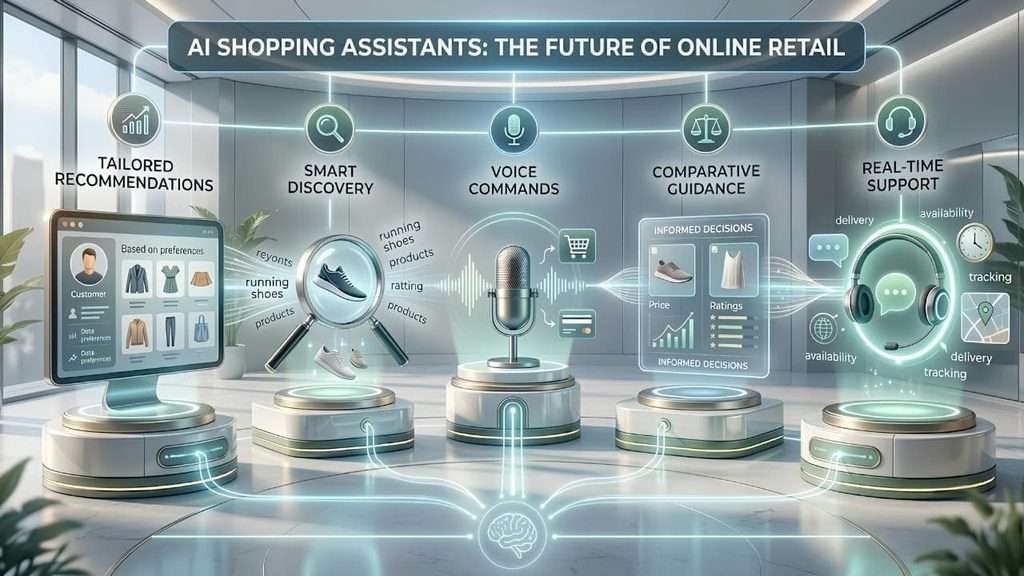
AI Shopping Assistants are transforming online retail by helping customers discover products, compare options, and make faster purchasing decisions. Unlike traditional chatbots, these intelligent assistants understand customer preferences, shopping behavior, and purchase history to deliver highly personalized recommendations. As AI technology continues to evolve, shopping assistants are becoming an essential tool for improving customer experiences and increasing sales.
How AI Shopping Assistants Improve Online Shopping
- Personalized Product Recommendations: Suggest products based on browsing history, preferences, and previous purchases.
- Smart Product Discovery: Help shoppers find products using natural language.
- Voice-Based Shopping: Enable customers to search, compare, and purchase products using voice commands.
- Intelligent Buying Guidance: Compare features, prices, ratings, and reviews to help customers make informed decisions.
- Real-Time Shopping Support: Answer questions about availability, delivery timelines, returns, and payment options instantly.
Real-World Use Cases of AI Chatbot for eCommerce
Businesses across different industries use AI Chatbot for eCommerce to simplify customer interactions, improve shopping experiences, and increase sales. From product discovery to post-purchase support, AI chatbots help customers complete tasks quickly while reducing the workload for support teams.
Popular Use Cases of AI Chatbots
- Fashion & Apparel: Recommend outfits, suggest the right size, and notify customers about new collections.
- Electronics Stores: Compare product specifications and recommend devices based on customer needs.
- Beauty & Cosmetics: Suggest skincare or makeup products based on skin type and preferences.
- Grocery & Retail: Help customers reorder frequently purchased items and provide delivery updates.
- Furniture & Home Décor: Recommend products based on room size, style, and budget.
- B2B eCommerce: Assist businesses with bulk orders, pricing inquiries, and product availability.
How to Choose the Right AI Chatbot for Your eCommerce Business
Selecting the right AI Chatbot for eCommerce starts with understanding your business goals and customer needs. The ideal chatbot should improve customer experience, integrate with your existing platforms, and scale as your business grows. According to IBM, 85% of retail and eCommerce businesses have already implemented chatbots, making it essential to choose a solution that delivers measurable value and a competitive advantage.
Checklist for Choosing the Right AI Chatbot
- Define Your Goals: Decide whether you need customer support, lead generation, or sales assistance.
- Check Platform Integration: Ensure compatibility with Shopify, WooCommerce, Magento, or your CRM.
- Evaluate AI Capabilities: Look for NLP, Generative AI, multilingual support, and personalization.
- Review Analytics: Choose a chatbot with conversation insights and performance reports.
- Prioritize Security: Ensure it protects customer data and complies with privacy regulations.
- Plan for Scalability: Select a solution that grows with your business.
| Selection Factor | Why It Matters | Example |
| AI Features | Delivers intelligent conversations | Personalized product recommendations |
| Integrations | Connects with existing systems | Shopify + CRM integration |
| Scalability | Supports business growth | Handles seasonal traffic spikes |
| Analytics | Measures chatbot performance | Tracks conversions and customer queries |
| Security | Protects customer information | Secure payment and customer data |
Best Practices for Implementing an AI Chatbot
Implementing an AI Chatbot for eCommerce requires careful planning to deliver a seamless customer experience. Instead of deploying a chatbot without a strategy, businesses should focus on clear objectives, high-quality data, and continuous optimization. Following best practices helps improve AI Chatbot for eCommerce accuracy, customer satisfaction, and overall business performance.
Best Practices for Successful Implementation
- Define Clear Business Goals: Identify whether your chatbot will focus on customer support, sales, lead generation, or order tracking.
- Train the Chatbot with Quality Data: Provide accurate product information, FAQs, and customer interaction history to improve responses.
- Integrate with Existing Systems: Connect the chatbot with your eCommerce platform, CRM, payment gateway, and inventory management system.
- Monitor Performance Regularly: Track response accuracy, customer satisfaction, and conversion rates to identify improvement opportunities.
- Continuously Optimize: Update the chatbot using customer feedback, new products, and changing business requirements.
Future Trends in AI Chatbots for eCommerce
The future of AI Chatbot for eCommerce goes far beyond answering customer questions. Emerging AI technologies will enable chatbots to act as intelligent shopping companions, automate complex business tasks, and deliver hyper-personalized experiences. As customer expectations continue to evolve, businesses that adopt these innovations will gain a competitive advantage and build stronger customer relationships.
Emerging Trends to Watch
- AI Agents for Autonomous Shopping: AI agents will complete tasks such as placing orders, processing returns, and tracking deliveries without human intervention.
- Hyper-Personalization: Analyze customer behavior to deliver tailored product recommendations and exclusive offers.
- Voice Commerce: Enable customers to search, compare, and purchase products using voice commands.
- Visual Search Integration: Allow shoppers to upload product images and instantly find similar items.
- Predictive Shopping: Recommend products before customers actively search based on browsing patterns and purchase history.
- AI Copilots for Online Stores: Support customers throughout the buying journey with intelligent guidance and real-time assistance.
As AI technology advances, AI Chatbots for eCommerce will become smarter, more proactive, and essential for delivering seamless, personalized shopping experiences.
Ready to move beyond chatbots that only answer questions? Discover how an AI Chatbot for eCommerce can recommend products, recover abandoned carts, automate customer support, and drive meaningful business actions. Explore how AI-powered automation can transform every stage of your customer journey.
Conclusion
An AI Chatbot for eCommerce does more than answer customer questions—it takes intelligent actions that improve every stage of the shopping journey. From personalized product recommendations and automated customer support to cart recovery, order tracking, and AI-powered assistance, modern chatbots help businesses enhance customer experiences while increasing efficiency and conversions. As Generative AI, AI Assistants, and AI Agents continue to evolve, adopting an action-driven AI chatbot will help eCommerce businesses stay competitive, build stronger customer relationships, and deliver smarter online shopping experiences.
Frequently Asked Questions (FAQs)
1. What is an AI Chatbot for eCommerce?
An AI Chatbot for eCommerce is an intelligent virtual assistant that uses artificial intelligence and natural language processing (NLP) to interact with customers, answer questions, recommend products, track orders, and provide 24/7 support. It helps businesses improve customer experience while increasing operational efficiency.
2. How does an AI Chatbot improve the eCommerce customer experience?
An AI chatbot for eCommerce delivers instant responses, personalized product recommendations, real-time order updates, and automated customer support. By reducing response times and offering relevant assistance, it creates a smoother and more engaging shopping experience.
3. What is the difference between an AI Chatbot, an AI Assistant, and an AI Agent?
An AI Chatbot answers customer questions and provides support, an AI Assistant offers personalized shopping guidance based on customer preferences, while an AI Agent can make decisions and complete tasks such as processing returns or managing workflows with minimal human intervention.
4. Can AI Chatbots increase eCommerce sales?
Yes. AI chatbots can increase sales by recommending relevant products, recovering abandoned carts, assisting customers during the buying process, and providing personalized shopping experiences that encourage higher conversions.
5. Which eCommerce platforms support AI Chatbots?
Most modern eCommerce platforms support AI chatbots, including Shopify, WooCommerce, Magento, BigCommerce, and custom-built online stores. Many chatbot solutions also integrate with CRM, payment gateways, and inventory management systems.
6. How does Generative AI improve eCommerce chatbots?
Generative AI enables chatbots to understand customer intent, generate human-like responses, provide personalized recommendations, and handle complex conversations more naturally than traditional rule-based chatbots.
7. Are AI Chatbots suitable for small and medium-sized businesses?
Yes. AI chatbots help businesses of all sizes automate customer support, reduce operational costs, and improve customer engagement. Many cloud-based chatbot platforms offer scalable solutions that grow with business needs.
8. What features should businesses look for in an AI Chatbot for eCommerce?
When choosing an AI chatbot, businesses should look for features such as:
- Natural Language Processing (NLP)
- Generative AI capabilities
- Personalized product recommendations
- Multilingual support
- CRM and eCommerce platform integration
- Analytics and reporting
- Strong security and data protection
9. Can AI Chatbots handle customer support 24/7?
Yes. AI chatbots operate around the clock, providing instant answers to customer questions, assisting with product searches, tracking orders, and resolving common issues without requiring human intervention.
10. What is the future of AI Chatbots in eCommerce?
The future of AI chatbots includes autonomous AI agents, voice commerce, visual search, predictive shopping, and hyper-personalized customer experiences. These innovations will help businesses deliver smarter interactions, improve customer satisfaction, and drive long-term growth.