

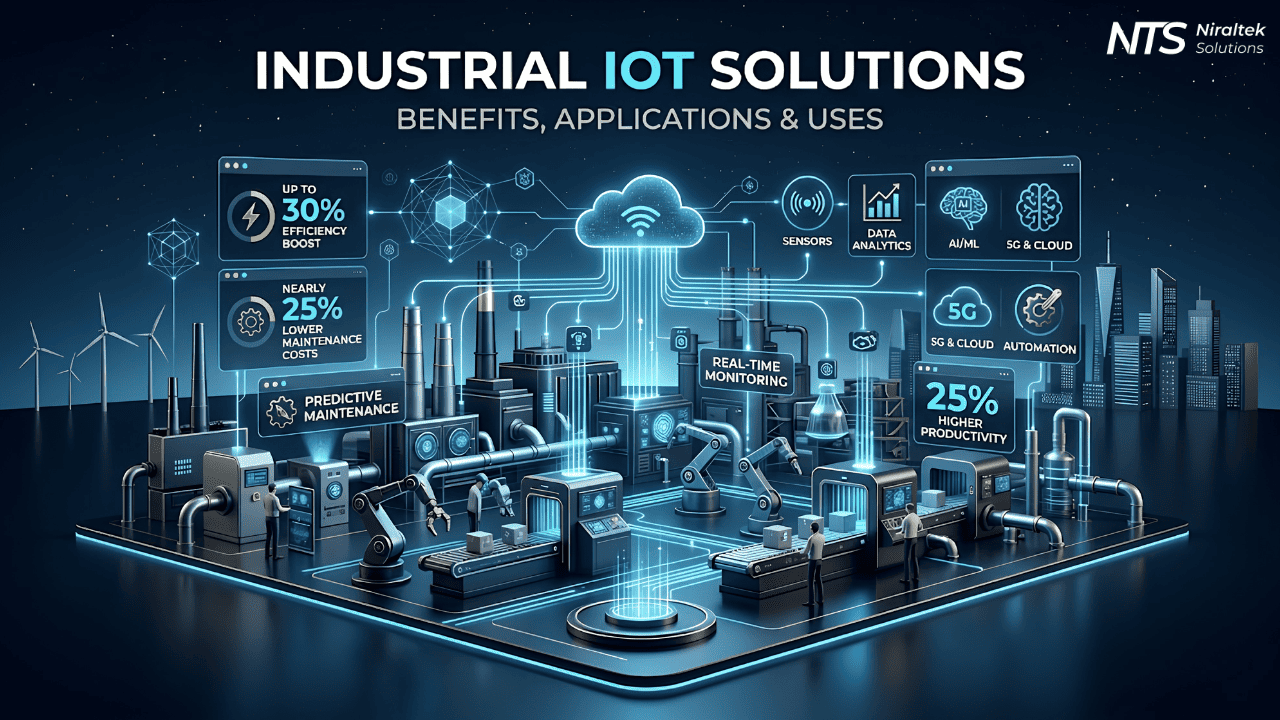
Industrial businesses face growing challenges, including unexpected equipment downtime, inefficient operations, and rising operating costs. Without real-time visibility into machines and industrial processes, identifying problems early and improving performance can be difficult. This is where Industrial IoT solutions help businesses make smarter, data-driven decisions.
By connecting industrial equipment, sensors, and monitoring systems, businesses can gain real-time insights into their operations, identify potential issues, and improve maintenance planning.
According to insights from McKinsey & Company, manufacturers are increasingly adopting Industrial IoT and advanced analytics to improve operational efficiency, reduce unplanned downtime, and optimize maintenance strategies.
Key challenges industries face include:
- Lack of real-time monitoring and operational visibility
- Unexpected equipment failures and costly downtime
- Inefficient energy consumption and resource utilization
Industrial IoT solutions address these challenges through real-time monitoring, predictive maintenance, and data-driven decision-making. These capabilities help businesses improve operational efficiency, reduce unnecessary costs, and increase productivity.
What Are Industrial IoT Solutions?
Industrial IoT (IIoT) solutions connect machines, sensors, and systems to collect real-time data and improve industrial operations. Instead of relying on manual monitoring, businesses use IIoT to automate processes and make faster decisions.
Industrial IoT (IIoT) solutions can help businesses improve productivity, reduce equipment downtime, and optimize industrial operations by providing real-time data and insights.
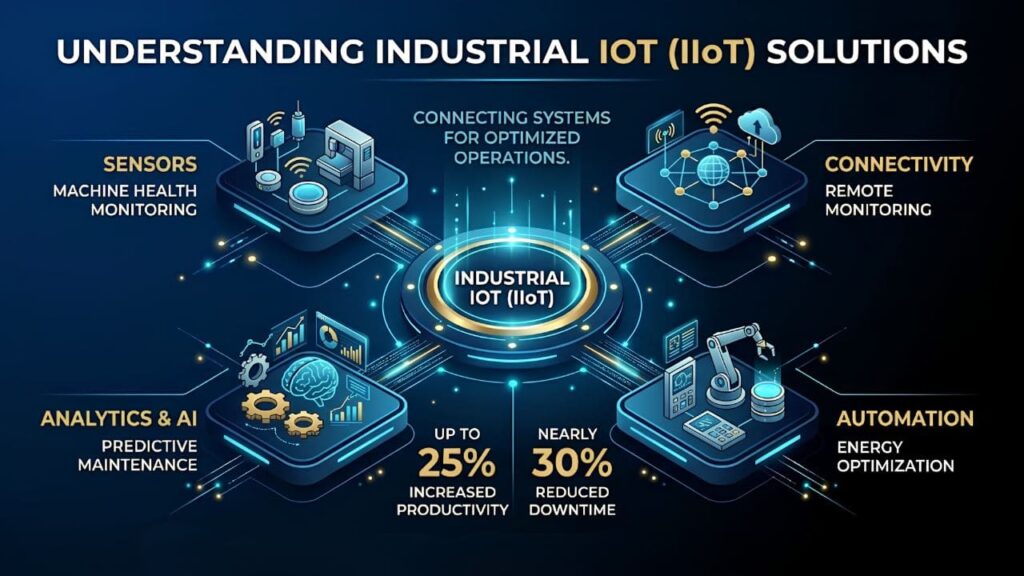
Key components include:
- Sensors and devices for data collection
- Connectivity (Wi-Fi, 5G, cloud platforms)
- Data analytics and AI tools
- Automation systems for control
Example:
A manufacturing plant uses sensors to monitor machine temperature and predict failures before breakdowns.
| Component | Function | Example Use Case |
| Sensors | Collect machine and process data | Equipment health monitoring |
| Connectivity | Transfer data between devices and systems | Remote monitoring |
| Analytics | Analyze data to identify patterns | Predictive maintenance |
| Automation systems | Support automated actions and control | Energy optimization |
IIoT solutions help industries operate smarter, faster, and more efficiently.
Why Industrial IoT Solutions Are Important Today
Industries face increasing pressure to manage complex operations, monitor equipment, and respond quickly to unexpected problems. Traditional monitoring methods may not provide the real-time visibility needed to identify issues across industrial processes. This makes Industrial IoT (IIoT) increasingly important for modern manufacturing and industrial environments.
Key Reasons Why IIoT Matters
- Real-time visibility: Access timely information about equipment and industrial processes.
- Reduced downtime: Identify potential equipment issues before they lead to unexpected interruptions.
- Operational efficiency: Use industrial data to identify performance issues and improve processes.
- Energy and cost management: Monitor energy consumption and maintenance requirements to support better resource management.
Example
For example, an automotive manufacturing plant could use Industrial IoT sensors to monitor robotic assembly-line motors. If a motor begins overheating, the system could generate an alert so engineers can investigate the issue before it causes an unexpected interruption.
Industrial IoT solutions help businesses make more informed decisions by providing better visibility into their operations and equipment.
Key Benefits of Industrial IoT Solutions
Industrial IoT solutions provide businesses with operational data that helps them understand equipment performance, identify inefficiencies, and make informed decisions. The benefits depend on how the technology is implemented and the needs of each industrial environment.
1. Improved Operational Efficiency
Industrial IoT systems collect data from connected machines and production processes. Analyzing this information helps teams identify performance bottlenecks, monitor operating conditions, and find opportunities to improve workflows.
2. Predictive Maintenance and Reduced Downtime
Sensors can monitor equipment conditions such as temperature and vibration. By analyzing changes in these measurements, maintenance teams can identify potential warning signs, investigate problems early, and plan maintenance activities before equipment failures disrupt operations.
3. Better Energy and Cost Management
Industrial IoT solutions can monitor energy consumption across equipment and production processes. This data helps businesses identify unusual usage patterns, understand where energy is being consumed, and make informed decisions about resource utilization and maintenance planning.
4. Enhanced Workplace Safety
Monitoring systems can track selected operating conditions and generate alerts when measurements exceed configured limits. These alerts help teams investigate potential hazards and respond to abnormal conditions. Their effectiveness depends on the sensors, system configuration, and safety procedures in place.
Practical Example
Consider a cement manufacturing plant that uses Industrial IoT sensors to monitor motor temperature and bearing vibration. If the system detects unusual readings, it can alert maintenance teams to investigate the equipment before a minor issue develops into a major disruption.
This example illustrates how equipment monitoring can support maintenance planning and help reduce unexpected interruptions. Actual results depend on the plant’s equipment, operating conditions, and implementation.
How Industrial IoT Solutions Work
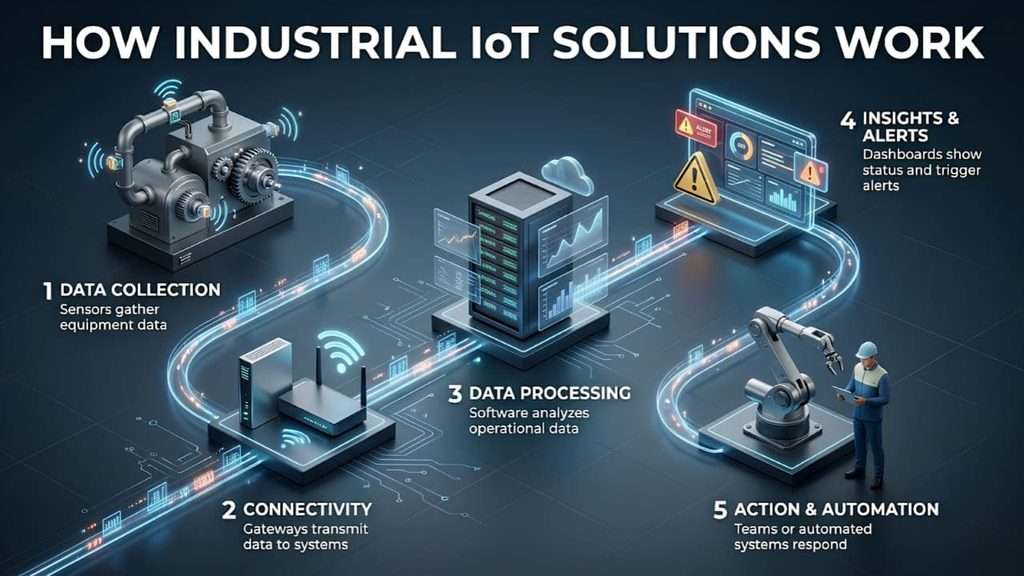
Industrial IoT solutions connect industrial equipment, sensors, communication networks, and software platforms to collect and process operational data. The process typically involves five key stages:
1. Data Collection
Sensors installed on industrial equipment collect operational data, such as temperature, pressure, vibration, and energy consumption.
2. Connectivity
Connected devices transfer the collected data through suitable communication networks and gateways to a monitoring platform or data-processing system.
3. Data Processing
Software processes and analyzes incoming data to identify patterns, unusual readings, or changes in equipment operating conditions.
4. Insights and Alerts
The system presents analyzed information through dashboards and can generate alerts when readings exceed predefined thresholds or indicate potential issues.
5. Action and Automation
Maintenance teams can investigate alerts and take appropriate action. Where automation is configured, connected control systems can also perform predefined actions.
This process creates a continuous flow of data from industrial equipment to monitoring systems, helping teams understand equipment conditions and respond to operational changes.
Real-World Applications of Industrial IoT Solutions
IoT-based solutions are transforming industries by providing real-time visibility, predictive insights, and intelligent automation.
Manufacturing: Smart factories use vibration and temperature sensors to monitor CNC machines, motors, and conveyor systems. This helps detect equipment wear early, reducing unplanned downtime and improving production efficiency.
Energy Management: Industrial facilities monitor electricity, compressed air, and water consumption in real time to identify energy waste, optimize resource usage, and reduce operational costs.
Oil & Gas: Industrial IoT solutions continuously monitor pipelines, storage tanks, and pressure levels. Real-time alerts help detect leaks early, improve worker safety, and minimize environmental risks.
Smart Buildings: Connected HVAC, lighting, and occupancy sensors automatically optimize energy consumption while maintaining occupant comfort and reducing utility costs.
Example:
A food processing company uses Industrial IoT sensors to continuously monitor storage temperature and humidity. When abnormal conditions are detected, the system sends alerts to operators, helping them respond promptly and maintain product quality.
Challenges in Implementing Industrial IoT
IoT-based solutions offer many benefits, but companies also face several challenges during implementation. Businesses must plan carefully to avoid costly mistakes and delays.
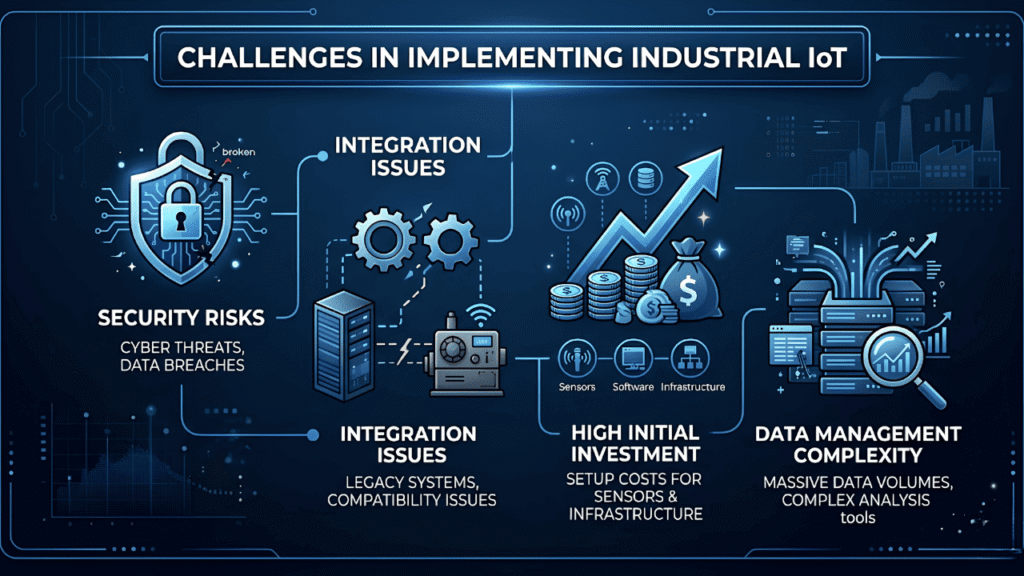
Industrial IoT projects can face implementation challenges related to system integration, cybersecurity, infrastructure costs, and data management. Understanding these challenges helps businesses plan their implementation more effectively.
Common challenges include:
- Data security risks: Connected devices increase exposure to cyber threats
- Integration issues: Legacy systems often struggle to connect with modern IoT platforms
- High initial investment: Setup costs for sensors, software, and infrastructure can be significant
- Data management complexity: Large volumes of data require proper analysis tools
Example:
A factory tries to connect old machines with IoT sensors but faces compatibility issues, delaying implementation.
| Challenge | Impact | Example |
| Security risks | Potential data breaches | Unauthorized system access |
| Integration issues | Compatibility problems | Difficulty connecting older machines |
| High initial cost | Budget constraints | Investment in sensors and infrastructure |
| Data management complexity | Difficulty interpreting large volumes of data | Important insights may be overlooked |
Understanding these challenges helps businesses plan better and implement IIoT solutions successfully.
How to Choose the Right Industrial IoT Solutions
Choosing the right IoT-based solutions can make a big difference in performance and cost savings. You need a solution that fits your business goals and scales with your operations.
Key factors to consider:
- Define your goals: Identify whether you want to reduce downtime, improve efficiency, or optimize energy usage
- Check scalability: Choose a solution that grows with your business needs
- Evaluate integration: Ensure it connects easily with your existing systems
- Focus on security: Protect your data with strong cybersecurity features
Example:
A manufacturing company selects an IoT solution that integrates with its old machines and adds predictive maintenance features. This helps reduce breakdowns and improve productivity.
Always choose a reliable provider with industry experience. A well-chosen solution ensures better performance, lower costs, and long-term success.
Future Trends in Industrial IoT Solutions
Industrial IoT continues to evolve rapidly, bringing smarter and more advanced technologies into industries. Businesses now focus on automation, real-time insights, and predictive systems to stay competitive.
Key future trends include:
- AI and Machine Learning: Systems analyze data and predict failures before they occur
- Edge Computing: Devices process data locally, reducing delays and improving speed
- 5G Connectivity: Faster networks enable real-time communication between devices
- Digital Twins: Virtual models simulate real systems for better decision-making
Looking to modernize your industrial operations? Discover Niraltek’s complete portfolio of Industrial IoT platforms, Smart Energy Monitoring Systems, AI Video Analytics, Industrial IoT Gateways, and automation solutions designed to improve operational efficiency and support digital transformation.
Conclusion
Industrial IoT solutions enable businesses to connect industrial equipment, collect operational data, and gain better visibility into their processes. From equipment monitoring to energy management, these technologies support more informed decisions across industrial environments.
Choosing the right Industrial IoT solution depends on your operational requirements, existing infrastructure, integration needs, and security considerations. By evaluating these factors, businesses can identify suitable Industrial IoT solutions to support their operational goals and long-term growth.
Frequently Asked Questions (FAQs)
What are Industrial IoT solutions?
Industrial IoT (IIoT) connects machines, sensors, and systems to collect real-time data and improve industrial operations. These smart technologies help businesses automate processes, reduce downtime, and increase efficiency.
How do these systems improve efficiency?
They provide real-time monitoring and predictive insights. Businesses can detect issues early, optimize performance, and reduce manual effort through data-driven decisions.
Which industries use IIoT?
Industries such as manufacturing, energy, oil and gas, and smart buildings use these technologies to improve productivity, reduce costs, and enhance safety.
Are these solutions secure?
Yes, modern systems include strong security features like encryption, access control, and continuous monitoring to protect data and connected devices.
What is the difference between IoT and IIoT?
IoT (Internet of Things) focuses on consumer applications like smart homes. IIoT focuses on industrial environments such as factories, energy systems, and automation processes.