

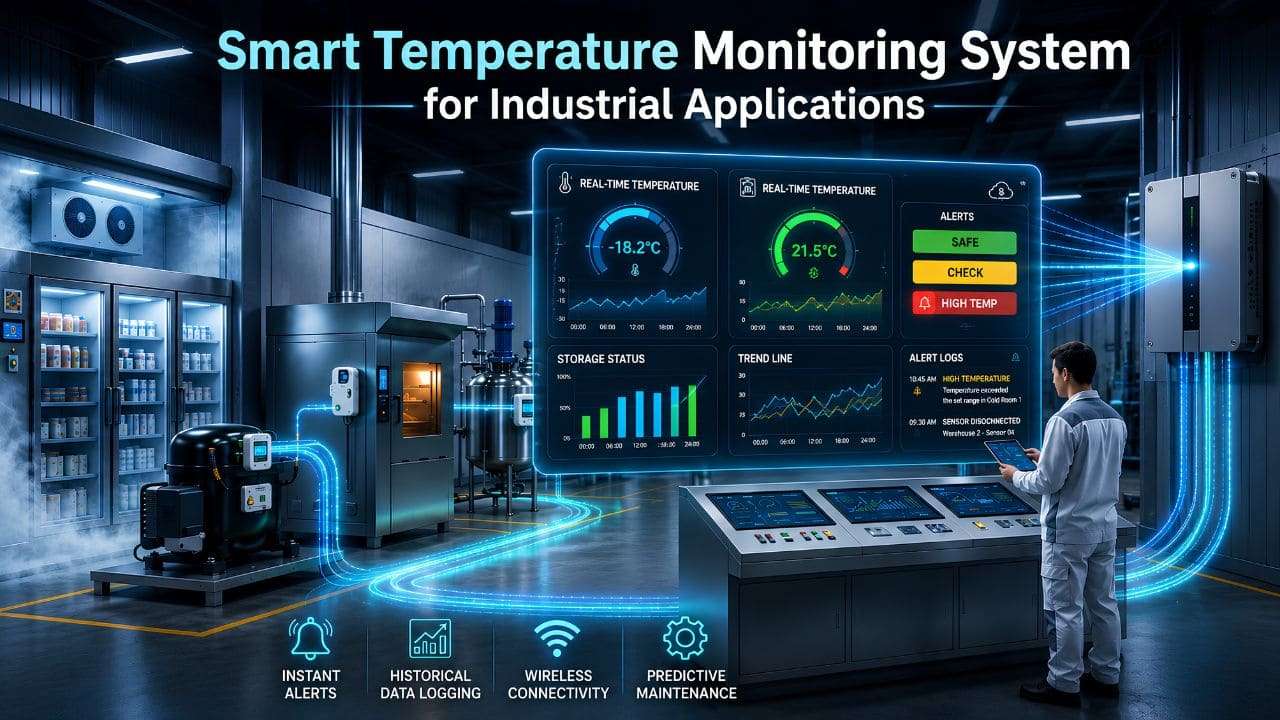
Maintaining the right temperature is critical for protecting products, ensuring regulatory compliance, and preventing costly operational disruptions. Even a small temperature fluctuation can lead to product spoilage, equipment failure, or quality issues in industries such as food processing, pharmaceuticals, healthcare, manufacturing, and cold storage. A smart Temperature Monitoring System provides continuous, real-time monitoring, automated alerts, and remote access to help businesses respond before problems escalate.
Why temperature monitoring matters:
- 526 million tonnes (12%) of global food are lost or wasted due to insufficient refrigeration and cold-chain infrastructure, according to the FAO.
- 866 million people fall ill every year from unsafe food, highlighting the importance of proper storage and temperature control.
- An IoT-enabled monitoring solution delivers real-time visibility, instant alerts, historical data logging, and remote monitoring, helping organizations reduce losses, improve operational efficiency, and maintain compliance across critical environments.
What is a Smart Temperature Monitoring System?
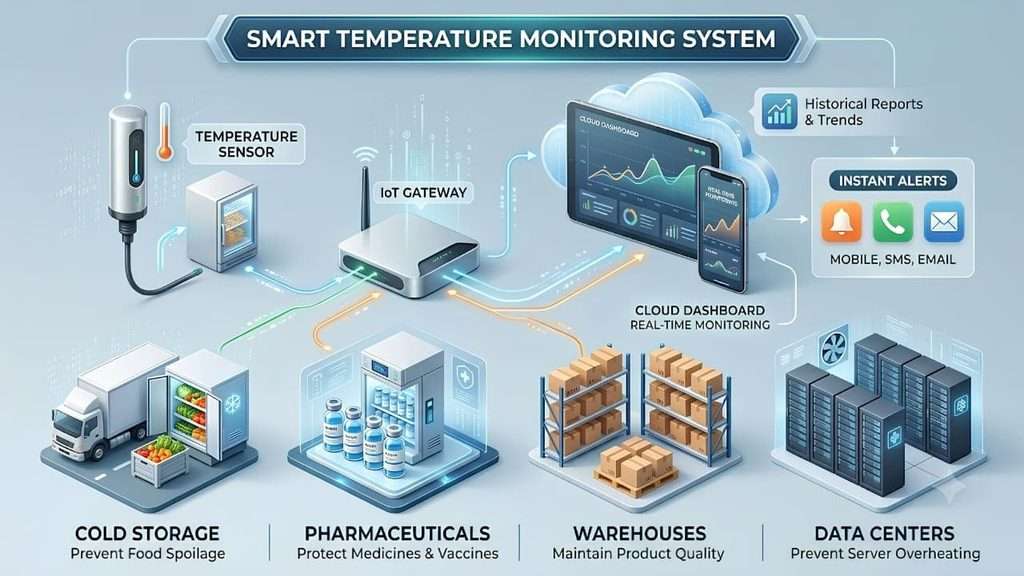
A Smart Temperature Monitoring System is a smart solution that continuously measures, records, and tracks temperature in real time. It uses sensors, IoT gateways, and cloud-based software to monitor environmental conditions and immediately notify users if temperatures exceed predefined limits. Businesses rely on these systems to protect sensitive products, maintain quality, and comply with industry regulations.
Key Components
- Temperature sensors for accurate data collection
- IoT Gateway for secure data transmission
- Cloud dashboard for real-time monitoring
- Mobile, SMS, and email alerts
- Historical reports and trend analysis
Common Applications
| Industry | Purpose |
| Cold Storage | Prevent food spoilage |
| Pharmaceuticals | Protect temperature-sensitive medicines and vaccines |
| Warehouses | Maintain product quality |
| Manufacturing | Monitor machinery and production environments |
| Data Centers | Prevent server overheating |
Why Temperature Monitoring is Important
Temperature plays a critical role in maintaining product quality, equipment performance, and workplace safety. Even a slight temperature variation can damage sensitive products, increase operational costs, and disrupt business processes. An IoT monitoring solution helps organizations detect issues early and take immediate action before they escalate.
Why It Matters
- Protect Product Quality: Keep food, pharmaceuticals, vaccines, and chemicals within safe temperature ranges.
- Reduce Product Loss: Prevent spoilage and inventory damage by identifying temperature fluctuations in real time.
- Improve Equipment Reliability: Monitor machines, refrigeration units, and electrical panels to prevent overheating and unexpected failures.
- Support Regulatory Compliance: Maintain accurate temperature records to meet standards such as HACCP, GMP, and GDP.
- Lower Operational Costs: Detect cooling or heating issues early, reducing energy waste and expensive repairs.
Common Temperature Monitoring Challenges in Industrial Facilities
Maintaining consistent temperatures across industrial facilities is not always easy. Manual monitoring, equipment failures, and delayed responses can increase operational risks, reduce product quality, and lead to costly losses. Identifying these challenges early helps businesses implement a smarter and more reliable monitoring strategy.
Common Challenges
- Manual Temperature Checks: Periodic inspections may miss sudden temperature fluctuations between scheduled readings.
- Equipment Failures: Refrigeration units, HVAC systems, and industrial machines can overheat or malfunction without early warning.
- Lack of Real-Time Visibility: Without continuous monitoring, businesses cannot detect issues until products or equipment are already affected.
- Delayed Alerts: Slow response times can result in product spoilage, production downtime, or compliance violations.
- Multi-Site Monitoring Complexity: Managing temperature across warehouses, cold storage facilities, and manufacturing plants becomes difficult without centralized monitoring.
Key Features of an IoT Temperature Monitoring System
An IoT Smart Temperature Monitoring System offers much more than temperature measurement. It delivers real-time visibility, automated alerts, and remote access, helping businesses monitor critical environments, reduce risks, and improve operational efficiency.
Key Features
- Real-Time Temperature Monitoring: Track temperature continuously and identify changes instantly.
- Remote Monitoring: View live data from a mobile phone, tablet, or computer, anytime and anywhere.
- Instant Alerts: Receive SMS, email, or app notifications when temperatures exceed predefined limits.
- Cloud Dashboard: Access real-time data, charts, and reports from a centralized platform.
- Historical Data Logging: Store temperature records for trend analysis, audits, and compliance.
- Wireless Connectivity: Connect WiFi Temperature and Humidity Sensors or wireless IoT sensors without complex wiring.
- Custom Threshold Settings: Configure temperature limits based on your operational requirements.
How Real-Time Temperature Monitoring Prevents Costly Business Losses
Unexpected temperature changes can damage products, interrupt operations, and create expensive compliance issues. A Smart Temperature Monitoring System gives businesses continuous visibility into critical environments, allowing teams to detect problems and respond before losses occur.
How it protects your business
- Prevent Product Spoilage: Detect temperature fluctuations before food, medicines, or chemicals become unusable.
- Reduce Equipment Downtime: Identify overheating in refrigeration units and industrial machinery early.
- Improve Response Time: Send instant SMS, email, or mobile alerts to the responsible team.
- Support Compliance: Maintain accurate temperature records for audits and regulatory inspections.
Example: A pharmaceutical warehouse receives an alert when vaccine storage temperature rises above the safe limit. The maintenance team restores cooling within minutes, protecting valuable inventory and avoiding costly product loss.
By responding faster, businesses reduce waste, protect assets, and maintain uninterrupted operations.
Applications of Smart Temperature Monitoring Systems
Smart Temperature Monitoring System supports industries that rely on stable environmental conditions to protect products, equipment, and operations. By providing real-time temperature monitoring, instant alerts, and historical data, it helps businesses improve efficiency and reduce operational risks.
Common Applications
- Industrial Temperature Monitoring: Monitor production equipment and electrical panels to prevent overheating and unplanned downtime.
- Cold Storage Temperature Monitoring: Maintain ideal storage temperatures for dairy products, frozen foods, fruits, and vegetables.
- Warehouse Temperature Monitoring: Protect temperature-sensitive inventory such as chemicals, electronics, and consumer goods.
- Pharmaceutical & Healthcare Facilities: Store medicines, vaccines, and laboratory samples within recommended temperature ranges.
- Cold Chain Monitoring System: Track temperature during transportation to ensure product quality from storage to delivery.
- Temperature and Humidity Monitoring: Monitor both temperature and humidity in clean rooms, laboratories, museums, and food processing facilities.
Benefits of a Smart Temperature Monitoring System
A smart monitoring solution helps businesses protect valuable assets, improve operational efficiency, and maintain consistent product quality. Instead of relying on manual inspections, organizations can monitor temperature in real time and respond immediately to unexpected changes.
Key Benefits
- Protect Product Quality: Maintain optimal storage conditions for food, pharmaceuticals, chemicals, and other temperature-sensitive products.
- Reduce Product Loss: Receive instant alerts when temperatures exceed safe limits, allowing quick corrective action.
- Prevent Equipment Failures: Detect overheating in refrigeration units, machinery, and electrical panels before breakdowns occur.
- Lower Operating Costs: Identify cooling inefficiencies early, reducing energy consumption and maintenance expenses.
- Ensure Regulatory Compliance: Store accurate temperature records to support audits and meet standards such as HACCP, GMP, and GDP.
- Monitor from Anywhere: Access live temperature data, reports, and alerts through a secure cloud dashboard or mobile device.
How to Choose the Right Temperature Monitoring System
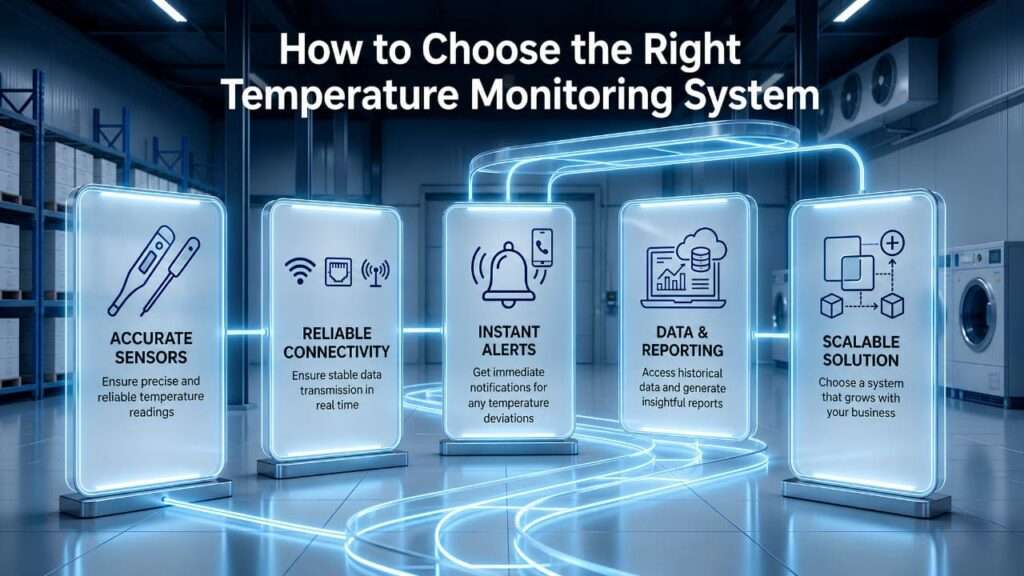
Choosing the right temperature monitoring solution helps protect products, improve operational efficiency, and simplify regulatory compliance. Look for a solution that offers accurate monitoring, reliable connectivity, and easy scalability as your business grows. The World Health Organization (WHO) recommends regular temperature mapping and continuous monitoring for pharmaceutical warehouses and cold storage facilities to maintain proper storage conditions.
What to Look For
- High-Accuracy Sensors: Ensure precise temperature measurements for critical applications.
- Reliable Connectivity: Support Wi-Fi, Ethernet, LoRaWAN, or 4G/5G for uninterrupted data transmission.
- Instant Alerts: Receive SMS, email, or mobile notifications during temperature excursions.
- Cloud Dashboard: Access live data, reports, and historical trends from anywhere.
- Scalable Design: Add more sensors or locations without replacing the system.
- Easy Integration: Connect with existing SCADA, BMS, or ERP platforms.
| Feature | Why It Matters |
| Sensor Accuracy | Ensures reliable temperature readings |
| Real-Time Alerts | Enables immediate corrective action |
| Cloud Dashboard | Provides remote monitoring and reporting |
| Historical Data | Supports audits and trend analysis |
| Multi-Site Monitoring | Manages multiple facilities from one platform |
Why Choose Niraltek Smart Temperature Monitoring System
Niraltek’s Smart Temperature Monitoring System combines Industrial IoT, cloud connectivity, and intelligent analytics to help businesses monitor temperature-sensitive environments with confidence. Whether you manage a cold storage facility, warehouse, pharmaceutical plant, or food processing unit, the solution delivers real-time visibility, instant alerts, and centralized monitoring to reduce product loss and improve operational efficiency.
Why Businesses Choose Niraltek
- Real-Time Temperature & Humidity Monitoring for continuous environmental tracking.
- Centralized Cloud Dashboard to monitor multiple locations from a single platform.
- Instant SMS, Email, and Mobile Alerts when temperatures exceed configured thresholds.
- Historical Reports & Analytics for trend analysis, compliance, and audits.
- IoT-Based Smart Sensor Integration with scalable deployment across facilities.
- Energy & Equipment Monitoring to improve refrigeration performance and reduce operational costs.
- AI-Driven Insights to identify anomalies early and support predictive maintenance.
Ready to improve temperature monitoring across your facility? Explore Niraltek’s Smart Temperature Monitoring System to gain real-time insights, receive instant alerts, and ensure reliable performance for warehouses, cold storage facilities, pharmaceutical storage, and industrial applications.
Conclusion
A Smart Temperature Monitoring System helps businesses protect products, improve operational efficiency, and maintain regulatory compliance. With real-time monitoring, instant alerts, and remote access, organizations can quickly respond to temperature fluctuations and reduce costly losses. Whether for warehouses, cold storage, pharmaceuticals, or manufacturing, IoT-enabled monitoring ensures reliable and uninterrupted operations. Investing in a smart temperature monitoring solution today helps build a safer, more efficient, and future-ready business.
Frequently Asked Questions (FAQs)
1. What is a Smart Temperature Monitoring System?
A Smart Temperature Monitoring System is an IoT-enabled solution that continuously measures, records, and tracks temperature in real time. It uses smart sensors, cloud dashboards, and instant alerts to help businesses protect products, improve operational efficiency, and maintain regulatory compliance.
2. How does an IoT temperature monitoring solution work?
An IoT monitoring solution collects temperature data through smart sensors and transfers it to a cloud platform using an IoT gateway. Users can monitor live data, receive instant alerts, and access historical reports from any connected device.
3. Which industries benefit from Industrial Temperature Monitoring?
Industrial Temperature Monitoring is widely used in:
- Manufacturing plants
- Cold storage facilities
- Warehouses
- Pharmaceutical industries
- Food processing units
- Healthcare facilities
- Cold chain logistics
- Data centers
4. What is the difference between Temperature Monitoring and Temperature & Humidity Monitoring?
Temperature Monitoring measures only temperature, while Temperature and Humidity Monitoring tracks both environmental conditions. Industries such as pharmaceuticals, laboratories, clean rooms, and food processing often require monitoring of both parameters.
5. Why is Cold Storage Temperature Monitoring important?
Cold Storage Temperature Monitoring helps maintain the ideal storage conditions for food, medicines, vaccines, dairy products, and frozen goods. Continuous monitoring reduces spoilage, protects product quality, and supports regulatory compliance.
6. What are the benefits of Remote Temperature Monitoring?
Remote Temperature Monitoring enables businesses to monitor critical environments from anywhere using a computer or mobile device. It provides real-time visibility, instant alerts, historical reports, and faster response to temperature fluctuations.
7. What is a Wireless Temperature Monitoring System?
A Wireless Temperature Monitoring System uses Wi-Fi, LoRaWAN, Zigbee, or cellular connectivity to transmit temperature data without extensive wiring. It offers flexible installation, centralized monitoring, and easy scalability for multiple locations.
8. Can real-time monitoring send instant alerts?
Yes. Modern Real-Time Temperature Monitoring solutions automatically send SMS, email, or mobile app notifications whenever the temperature exceeds predefined limits, allowing teams to take immediate corrective action.
9. How do WiFi Temperature and Humidity Sensors work?
WiFi Temperature and Humidity Sensors continuously measure environmental conditions and securely transmit the data to a cloud dashboard. Users can monitor live readings, analyze historical trends, and receive automatic alerts from any location.
10. How do I choose the right monitoring solution for my business?
Choose a solution that offers accurate sensors, real-time monitoring, instant alerts, cloud-based dashboards, historical data logging, remote access, and seamless integration with your existing industrial systems. Businesses should also consider scalability, reliability, and ease of deployment.