

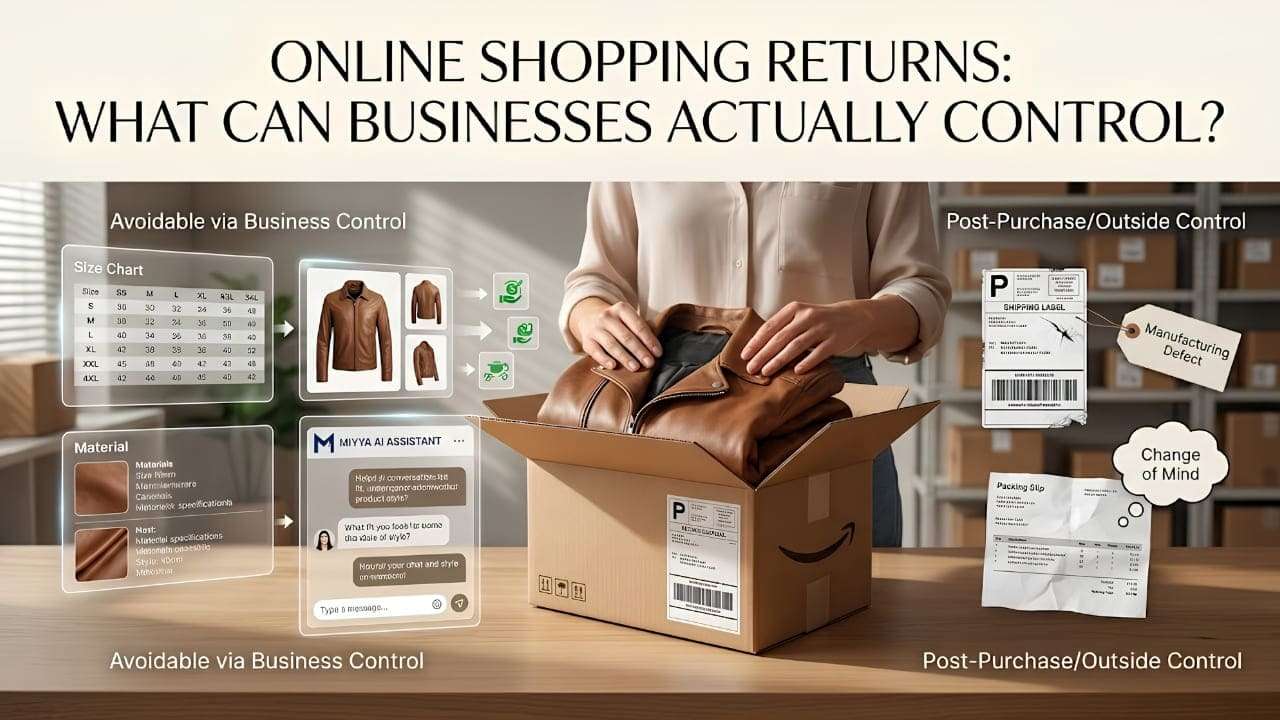
Online shopping has made purchasing convenient, but it has also created a difficult question for retailers: why do customers return products that seemed right when they placed the order? The National Retail Federation estimated that 19.3% of online sales were expected to be returned in 2025, highlighting the scale of the challenge.
Common problems include:
- Choosing the wrong size, color, or variant
- Misunderstanding product features or compatibility
- Difficulty comparing similar products
- Expecting something different from the product received
Not every return can be prevented. However, better product information, clearer choices, and AI-assisted shopping can help customers make more informed decisions before checkout.
Online Shopping Returns Are Not All Caused by the Same Problem
Not every return reflects a poor purchase decision. Some returns begin with uncertainty before checkout, while others happen because of problems after the order is placed.
A useful way to look at online shopping returns is to separate them into two broad categories:
| Type of return | Example | Where the solution lies |
| Pre-purchase decision | Wrong size, variant, or misunderstood feature | Better product information and shopping guidance |
| Product expectation | Product looks or works differently than expected | Accurate images, descriptions, and specifications |
| Fulfillment problem | Wrong or damaged product arrives | Better warehouse and logistics processes |
| Post-purchase decision | Customer changes their mind | Return policy and customer service |
This distinction matters because businesses do not have equal control over every return.
Problems such as unclear product information, confusing variants, and difficult product comparisons can be addressed before checkout. Fulfillment errors, product defects, and shipping damage require operational solutions after the purchase.
Understanding where a return originates is the first step toward deciding what a business can actually influence.
What Can an eCommerce Business Actually Control?
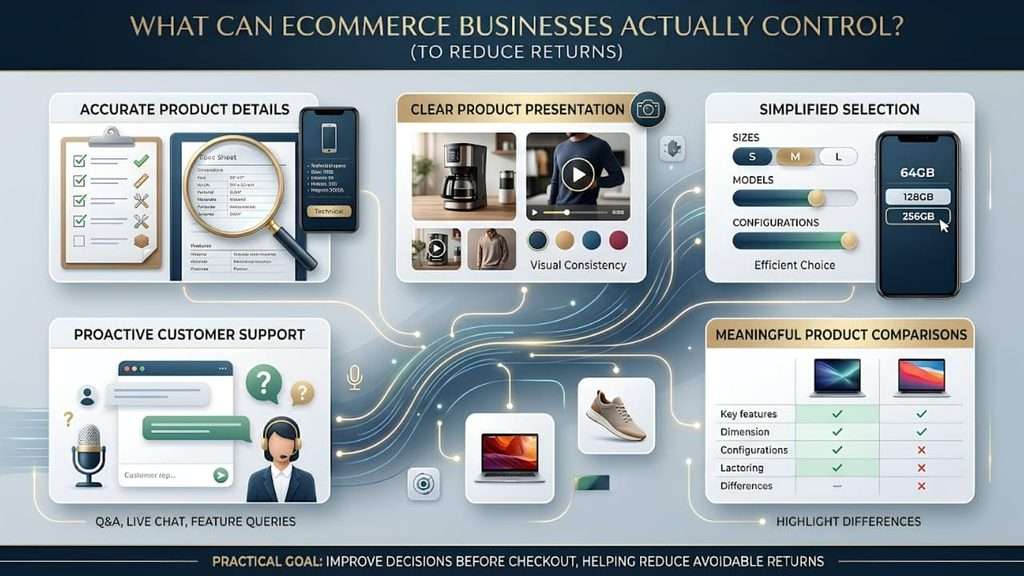
Before blaming customers for online shopping returns, businesses should look at the parts of the shopping experience they can improve. A customer cannot make a confident choice if important product information remains unclear.
Businesses can control:
- Product information: Provide accurate specifications, dimensions, materials, and compatibility details.
- Product presentation: Use clear images, videos, color descriptions, and variant names.
- Product selection: Make sizes, models, storage options, and configurations easy to understand.
- Customer questions: Give shoppers a simple way to ask about features, compatibility, or usage.
- Product comparison: Show meaningful differences between similar products.
For example, if a customer needs a phone with 256GB storage, the store should clearly display storage options rather than making the customer search through several sections.
However, businesses cannot control every cause of online shopping returns. A customer may still change their mind, or a product may arrive damaged. The practical goal is to improve the decisions businesses can influence before checkout, helping reduce avoidable online shopping returns.
The Information Problem: More Product Data Does Not Always Mean Better Decisions
An online store can provide detailed product pages and still leave customers unsure about what to buy, which can contribute to online shopping returns. The problem isn’t always missing information. Sometimes, customers simply don’t know which information matters for their situation.
A product page may contain:
- Technical specifications
- Multiple images
- Size and color options
- Compatibility details
- Product features
- Customer reviews
But consider a shopper looking for a laptop for video editing. They may see dozens of specifications but still ask, “Which one actually suits my work?”
For example, 16GB RAM may matter more to one shopper, while battery life or portability may matter more to another.
The challenge, therefore, isn’t just giving customers more data. It is helping them understand and use the relevant information when making a purchase decision.
Where Can AI Actually Help?
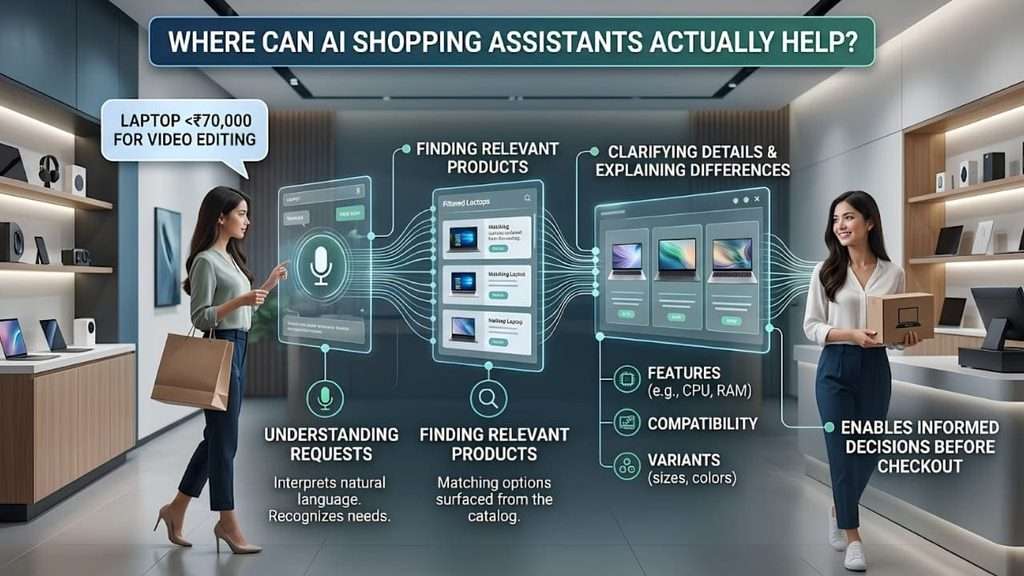
AI becomes useful when customers have information but struggle to turn it into a purchase decision. An AI shopping assistant can understand a shopper’s requirements, connect them with relevant product information, and help them explore available options.
For example, a customer might say, I need a laptop under ₹70,000 for video editing. Instead of browsing dozens of products, the assistant can help narrow the choices based on the information available in the store’s catalog.
AI can help with:
- Understanding requirements: Interpret natural-language shopping requests.
- Finding relevant products: Surface options that match stated needs.
- Clarifying details: Answer questions about features, specifications, and compatibility.
- Explaining differences: Help customers understand similar products.
- Handling variants: Guide shoppers through available sizes, colors, models, or configurations.
The goal isn’t to promise a perfect purchase. It is to make product information easier to understand, so customers can make more informed decisions before checkout.
What AI Cannot Control
AI can improve the pre-purchase experience, but it cannot solve every reason behind online shopping returns. Some problems happen outside the shopping conversation, and businesses need operational solutions for them.
AI cannot directly control:
- Product quality: A manufacturing defect still requires quality control and inspection.
- Shipping damage: If a product gets damaged during delivery, better recommendations cannot prevent it.
- Warehouse errors: Sending the wrong product requires accurate order processing and fulfillment.
- Incorrect product data: If a store lists the wrong color, size, or specification, AI may repeat that inaccurate information.
- Customer decisions: A shopper can still change their mind after receiving the product.
For example, an AI assistant may help a customer choose a blue shirt based on the store’s catalog. But if the warehouse ships the wrong color, the problem occurs after the purchase decision.
AI Is Only as Reliable as the Product Information Behind It
An AI shopping assistant can guide customers, but it cannot create accurate product facts from incorrect data. The quality of the shopping experience still depends on the information a business provides.
Before using AI, stores should keep these details accurate:
- Product specifications: Ensure features, dimensions, capacity, and technical details match the actual product.
- Variants: Keep colors, sizes, models, and configurations updated.
- Compatibility: Clearly state which devices, systems, or accessories work together.
- Availability: Keep inventory information current.
- Product images: Use visuals that represent the product accurately.
For example, if a store lists a laptop with 16GB RAM when the actual model has 8GB, an AI assistant may use that incorrect information when answering a customer.
AI can organize and explain product information, but businesses remain responsible for keeping that information accurate. Better data gives AI a stronger foundation for helping shoppers make informed decisions.
From Search to Conversation: A Different Way to Shop
Traditional product search usually starts with keywords. But shoppers often know what they want without knowing exactly what to type.
Imagine someone looking for a laptop for video editing under ₹70,000. Instead of trying different keywords and opening multiple product pages, they could simply ask:
I need a laptop for video editing, good battery life, and at least 16GB RAM. Which options should I consider?
This changes the shopping experience in a few simple ways:
- Search starts with keywords; conversation starts with a need.
- Filters narrow choices; questions help clarify what matters.
- Product pages provide information; conversations can make that information easier to understand.
- Shoppers can continue asking questions instead of starting a new search each time.
For example, the customer can follow up with, “Which option has better battery life?” without repeating the entire search.
The goal is not to replace product search. It is to make product discovery more natural and help customers navigate their choices with greater clarity.
A Realistic Example: One Customer, One Purchase Decision
Consider a customer looking for wireless headphones for daily travel. They have a budget of ₹5,000 and care about comfort and battery life, but several models look similar.
Instead of opening product pages one after another, the customer can simply ask:
I need comfortable headphones for daily travel with long battery life. My budget is ₹5,000. Which options should I consider?”
The conversation can continue as the customer explores the available choices:
- Which option has the longest battery life?
- Which one would be more comfortable for daily travel?
- Does this model work with my phone?
These follow-up questions help the customer clear up uncertainties before placing the order.
The customer still makes the final decision. The value comes from making the available choices easier to understand, rather than simply showing another list of products.
Where MIYYA AI Fits Into This Shopping Experience
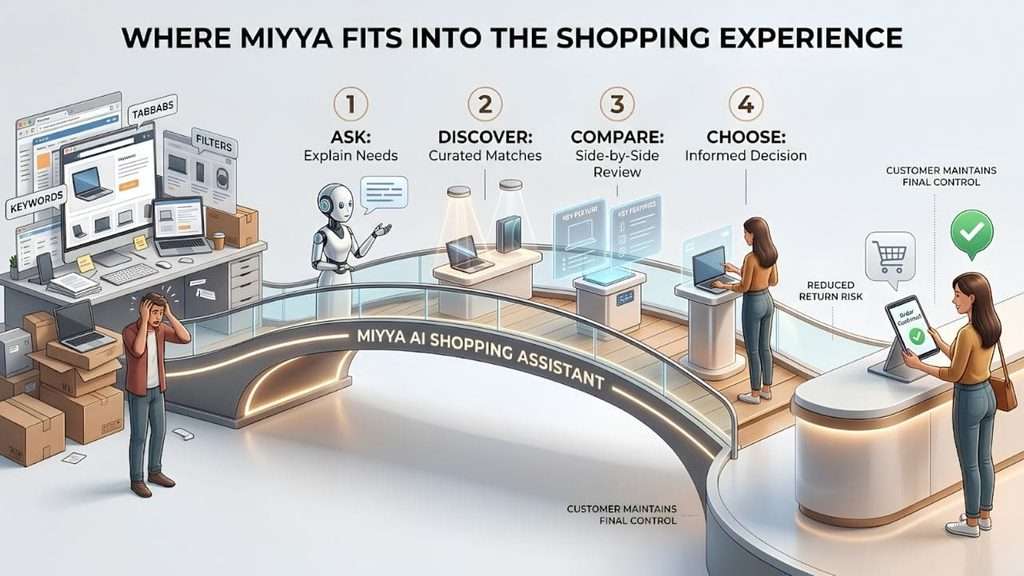
This is where MIYYA AI Shopping Assistant fits into the customer journey. Instead of making shoppers depend only on keywords, filters, and multiple product pages, MIYYA lets them interact with products through conversation.
For example, a customer could ask:
I need a lightweight laptop for work and travel, under ₹60,000. What should I look at?
MIYYA AI can help the shopper move through four simple steps:
- Ask: Understand what the customer actually needs.
- Discover: Find relevant products from the available catalog.
- Compare: Explain key differences between suitable options.
- Choose: Help the customer make a more informed decision.
The customer still controls the final purchase. MIYYA does not guarantee that online shopping returns will never happen. Instead, it helps address decision-related challenges before checkout by making product discovery and comparison more conversational.
For eCommerce businesses, this approach can make the shopping journey more interactive while helping customers navigate large product catalogs with less effort.
How Businesses Can Measure Whether AI Is Helping
Businesses should not judge an AI shopping assistant only by how many conversations it handles. They should look at what changes after customers use it.
Track metrics such as:
- Online shopping returns: Compare return rates before and after introducing AI assistance.
- Return reasons: Check whether size, variant, compatibility, or product-selection returns change.
- Conversion rate: See whether assisted shoppers purchase more often.
- Product comparison: Measure how frequently shoppers use comparison or recommendation features.
- Customer questions: Track common questions to identify information gaps.
| Metric | What to Compare | Example |
| Return rate | Before vs. after AI | 12% → 10% |
| Variant returns | Return reason | 5% → 3% |
| Conversion rate | Assisted vs. non-assisted | 3% vs. 2.5% |
Help Customers Make Better Purchase Decisions Before Checkout
Online shopping returns can sometimes start with uncertainty about the right product, size, variant, or features. MIYYA AI Shopping Assistant helps eCommerce businesses create a conversational shopping experience where customers can ask questions, discover relevant products, compare options, and make more informed purchase decisions.
Conclusion
Online shopping returns are not simply a problem that businesses can solve after an order reaches the customer. In many cases, the opportunity starts much earlier—when a shopper is deciding what to buy.
Businesses can influence that decision by providing accurate product information, clear variants, useful comparisons, and answers to important customer questions. AI can support this process by making product information easier to navigate and helping shoppers evaluate their options before checkout.
But AI is not a solution for every return. Damaged products, manufacturing defects, fulfillment mistakes, and changes of mind require different solutions. The realistic goal is to reduce avoidable returns, not promise zero returns.
For eCommerce businesses, the next step is to measure what actually changes: return reasons, conversion, customer questions, and purchase behavior. Better information, better guidance, and better measurement can create a more confident shopping experience.
Frequently Asked Questions
1. What are the most common reasons customers return products online?
Online shopping returns often happen because customers choose the wrong size, color, model, or variant. Other common reasons include unclear product information, compatibility issues, unmet expectations, damaged products, and receiving an item different from what they ordered.
2. How can eCommerce businesses reduce product returns?
Businesses can reduce avoidable online shopping returns by providing accurate product descriptions, clear specifications, reliable images, updated variants, compatibility information, and helpful pre-purchase guidance. Making product comparison and selection easier can also support better purchase decisions.
3. What product information should an online store provide?
An online store should provide clear and accurate product information before checkout. Important details include dimensions, materials, specifications, compatibility, size guides, and available variants. This information helps customers understand the product and make a more informed purchase decision.
4. How does AI help customers choose the right product?
An AI shopping assistant can understand customer requirements through conversation, recommend relevant products, answer questions, explain differences, and help shoppers compare options. This gives customers another way to evaluate products before making a purchase.
5. Can an AI shopping assistant prevent all product returns?
No. AI cannot eliminate all returns because some problems happen after purchase, such as shipping damage, manufacturing defects, warehouse errors, or changes in customer preferences. AI mainly supports the decisions customers make before checkout.
6. What should businesses track to measure the impact of AI shopping assistance?
Businesses can compare return rates, return reasons, conversion rates, product comparisons, customer questions, and engagement before and after introducing AI assistance. These metrics can help identify whether shoppers make more informed purchase decisions.