

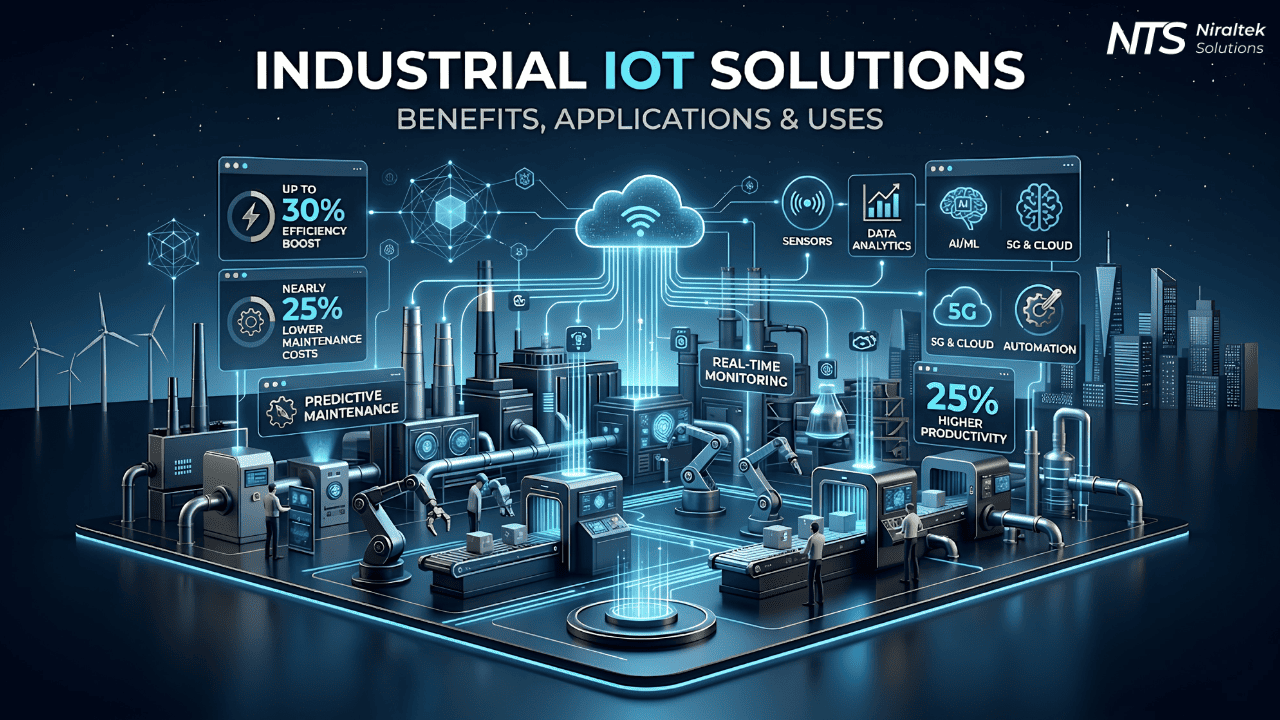
Industrial operations today face rising challenges-inefficiencies, unexpected downtime, and increasing operational costs. Traditional systems lack real-time visibility, making it difficult to optimize performance. This is where industrial IoT solutions are transforming industries.
According to insights from McKinsey & Company, manufacturers are increasingly adopting Industrial IoT and advanced analytics to improve operational efficiency, reduce unplanned downtime, and optimize maintenance strategies.
Key challenges industries face:
- Lack of real-time monitoring
- High equipment downtime
- Inefficient energy usage
Industrial IoT solutions address these issues by enabling smart monitoring, predictive maintenance, and data-driven decision-making, helping businesses achieve higher efficiency, reduced costs, and improved productivity.
What Are Industrial IoT Solutions?
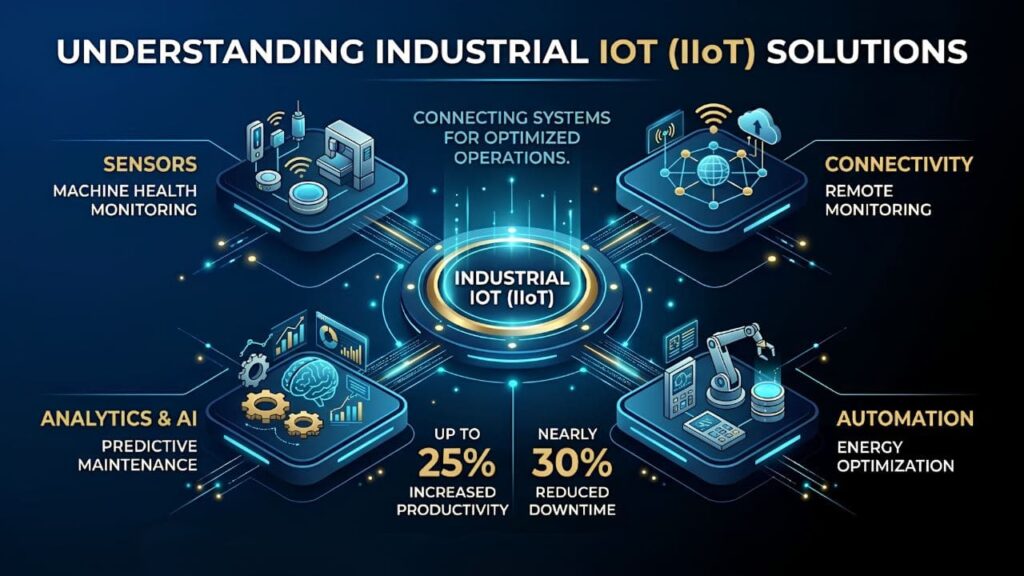
Industrial IoT (IIoT) solutions connect machines, sensors, and systems to collect real-time data and improve industrial operations. Instead of relying on manual monitoring, businesses use IIoT to automate processes and make faster decisions.
According to industry reports, IIoT can increase productivity by up to 25% and reduce downtime by nearly 30%.
Key components include:
- Sensors and devices for data collection
- Connectivity (Wi-Fi, 5G, cloud platforms)
- Data analytics and AI tools
- Automation systems for control
Example:
A manufacturing plant uses sensors to monitor machine temperature and predict failures before breakdowns.
| Component | Function | Example Use Case |
| Sensors | Collect real-time data | Machine health monitoring |
| Connectivity | Transfer data to cloud | Remote monitoring |
| Analytics | Analyze data for insights | Predictive maintenance |
| Automation | Control systems automatically | Energy optimization |
IIoT solutions help industries operate smarter, faster, and more efficiently.
Why Industrial IoT Solutions Are Important Today?
Industries today face constant pressure to improve efficiency, reduce costs, and avoid unexpected downtime. Traditional systems cannot keep up with real-time demands. That’s why industrial IoT solutions have become essential for modern operations.
Industrial IoT helps businesses monitor equipment, analyze performance, and make faster decisions using real-time data.
Key reasons why IIoT matters:
- Real-time visibility: Track machines and processes instantly
- Reduced downtime: Detect issues early and prevent failures
- Better efficiency: Optimize operations using data insights
- Cost savings: Reduce energy waste and maintenance costs
Example:
An automotive manufacturing company used Industrial IoT sensors to monitor robotic assembly lines. Real-time alerts helped engineers identify overheating motors before failure, reducing downtime and improving production efficiency.
Industries that adopt IIoT gain a competitive advantage by improving productivity, safety, and decision-making in today’s fast-changing industrial environment.
Key Benefits of Industrial IoT Solutions
Industrial IoT solutions help businesses run smarter, faster, and more efficiently. By connecting machines and systems, companies gain real-time insights and take quick action.
Key benefits include:
- Improved efficiency: Monitor operations in real time and optimize performance
- Reduced downtime: Predict failures before they happen
- Cost savings: Cut energy waste and maintenance expenses
- Enhanced safety: Detect risks early and prevent accidents
Real-World Example:
A cement manufacturing plant implemented Industrial IoT sensors to continuously monitor motor temperature and bearing vibration. By detecting abnormal conditions early, the plant reduced unplanned downtime by 27%, improved maintenance planning, and increased production efficiency.
How Industrial IoT Solutions Work
IoT (IIoT) solutions connect machines, sensors, and software to collect and use real-time data for smarter operations. They follow a simple but powerful process:
- Data Collection: Sensors installed on machines capture data like temperature, pressure, and energy usage.
- Connectivity: Devices send data through networks (Wi-Fi, cloud, or gateways) to a central system.
- Data Processing: Software analyzes incoming data using analytics or AI tools.
- Insights & Alerts: The system generates alerts or recommendations.
- Action & Automation: Teams or automated systems take action instantly.
This continuous loop helps industries improve efficiency, reduce downtime, and make faster decisions.
Real-World Applications of Industrial IoT Solutions
IoT-based solutions are transforming industries by providing real-time visibility, predictive insights, and intelligent automation.
Manufacturing: Smart factories use vibration and temperature sensors to monitor CNC machines, motors, and conveyor systems. This helps detect equipment wear early, reducing unplanned downtime and improving production efficiency.
Energy Management: Industrial facilities monitor electricity, compressed air, and water consumption in real time to identify energy waste, optimize resource usage, and reduce operational costs.
Oil & Gas: Industrial IoT solutions continuously monitor pipelines, storage tanks, and pressure levels. Real-time alerts help detect leaks early, improve worker safety, and minimize environmental risks.
Smart Buildings: Connected HVAC, lighting, and occupancy sensors automatically optimize energy consumption while maintaining occupant comfort and reducing utility costs.
Example:
A food processing company deployed Industrial IoT sensors to continuously monitor storage temperature and humidity. When abnormal conditions were detected, the system sent instant alerts to operators, preventing product spoilage and ensuring compliance with quality standards. different sectors.
Challenges in Implementing Industrial IoT
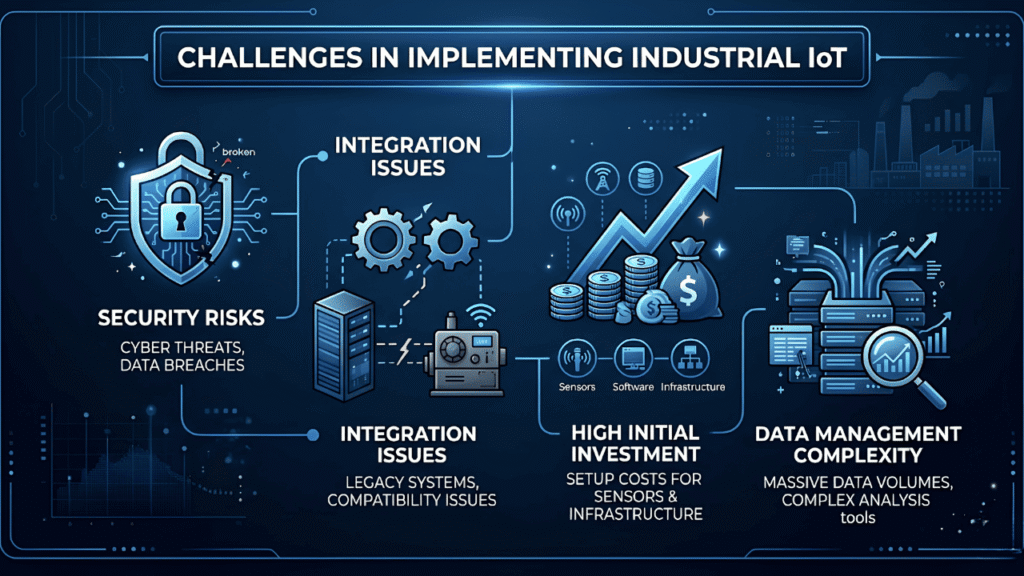
IoT-based solutions offer many benefits, but companies also face several challenges during implementation. Businesses must plan carefully to avoid costly mistakes and delays.
According to industry reports, nearly 70% of IIoT projects face delays due to integration and security issues.
Common challenges include:
- Data security risks: Connected devices increase exposure to cyber threats
- Integration issues: Legacy systems often struggle to connect with modern IoT platforms
- High initial investment: Setup costs for sensors, software, and infrastructure can be significant
- Data management complexity: Large volumes of data require proper analysis tools
Example:
A factory tries to connect old machines with IoT sensors but faces compatibility issues, delaying implementation.
| Challenge | Impact | Example |
| Security risks | Data breaches | Unauthorized system access |
| Integration issues | System incompatibility | Old machines not connecting |
| High cost | Budget constraints | Expensive setup |
| Data overload | Poor decision-making | Unanalyzed data |
Understanding these challenges helps businesses plan better and implement IIoT solutions successfully.
How to Choose the Right Industrial IoT Solutions
Choosing the right IoT-based solutions can make a big difference in performance and cost savings. You need a solution that fits your business goals and scales with your operations.
Key factors to consider:
- Define your goals: Identify whether you want to reduce downtime, improve efficiency, or optimize energy usage
- Check scalability: Choose a solution that grows with your business needs
- Evaluate integration: Ensure it connects easily with your existing systems
- Focus on security: Protect your data with strong cybersecurity features
Example:
A manufacturing company selects an IoT solution that integrates with its old machines and adds predictive maintenance features. This helps reduce breakdowns and improve productivity.
Always choose a reliable provider with industry experience. A well-chosen solution ensures better performance, lower costs, and long-term success.
Future Trends in Industrial IoT Solutions
Industrial IoT continues to evolve rapidly, bringing smarter and more advanced technologies into industries. Businesses now focus on automation, real-time insights, and predictive systems to stay competitive.
Key future trends include:
- AI and Machine Learning: Systems analyze data and predict failures before they occur
- Edge Computing: Devices process data locally, reducing delays and improving speed
- 5G Connectivity: Faster networks enable real-time communication between devices
- Digital Twins: Virtual models simulate real systems for better decision-making
Looking to modernize your industrial operations? Discover Niraltek’s complete portfolio of Industrial IoT platforms, Smart Energy Monitoring Systems, AI Video Analytics, Industrial IoT Gateways, and automation solutions designed to improve operational efficiency and support digital transformation.
Conclusion
Industrial IoT Solutions are no longer just a trend-they have become a necessity for modern industries aiming to stay competitive. By connecting machines, analyzing real-time data, and enabling smart decision-making, IIoT helps businesses improve efficiency, reduce downtime, and control operational costs.
From predictive maintenance to energy optimization, these solutions empower industries to move from reactive operations to intelligent, data-driven systems. Companies that adopt Industrial IoT early gain a significant advantage in productivity, safety, and long-term growth.
Frequently Asked Questions (FAQs)
What are Industrial IoT solutions?
Industrial IoT (IIoT) connects machines, sensors, and systems to collect real-time data and improve industrial operations. These smart technologies help businesses automate processes, reduce downtime, and increase efficiency.
How do these systems improve efficiency?
They provide real-time monitoring and predictive insights. Businesses can detect issues early, optimize performance, and reduce manual effort through data-driven decisions.
Which industries use IIoT?
Industries such as manufacturing, energy, oil and gas, and smart buildings use these technologies to improve productivity, reduce costs, and enhance safety.
Are these solutions secure?
Yes, modern systems include strong security features like encryption, access control, and continuous monitoring to protect data and connected devices.
What is the difference between IoT and IIoT?
IoT (Internet of Things) focuses on consumer applications like smart homes. IIoT focuses on industrial environments such as factories, energy systems, and automation processes.