

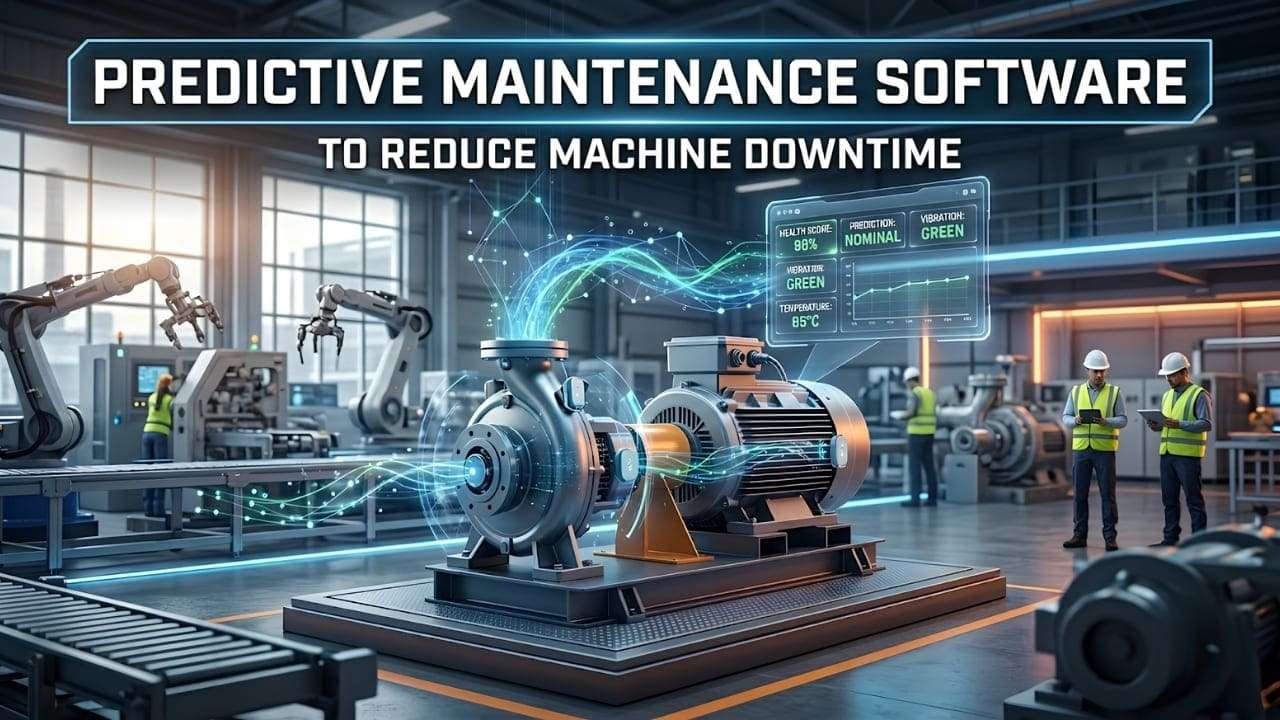
Unexpected machine failures can bring production to a halt, increase maintenance costs, and reduce overall equipment efficiency. The platform helps manufacturers prevent these issues by using Industrial IoT sensors, real-time data, and AI-driven analytics to identify potential equipment failures before they occur. According to McKinsey & Company, predictive maintenance can reduce unplanned downtime by 30–50% and lower maintenance costs by 10–40%, making it a key technology for smarter and more reliable manufacturing operations.
Key benefits of predictive maintenance software:
- Reduce unplanned machine downtime
- Improve asset health monitoring in real time
- Increase OEE and production efficiency
- Enable continuous equipment condition monitoring
- Optimize maintenance planning and operational costs
What Is Predictive Maintenance Software?
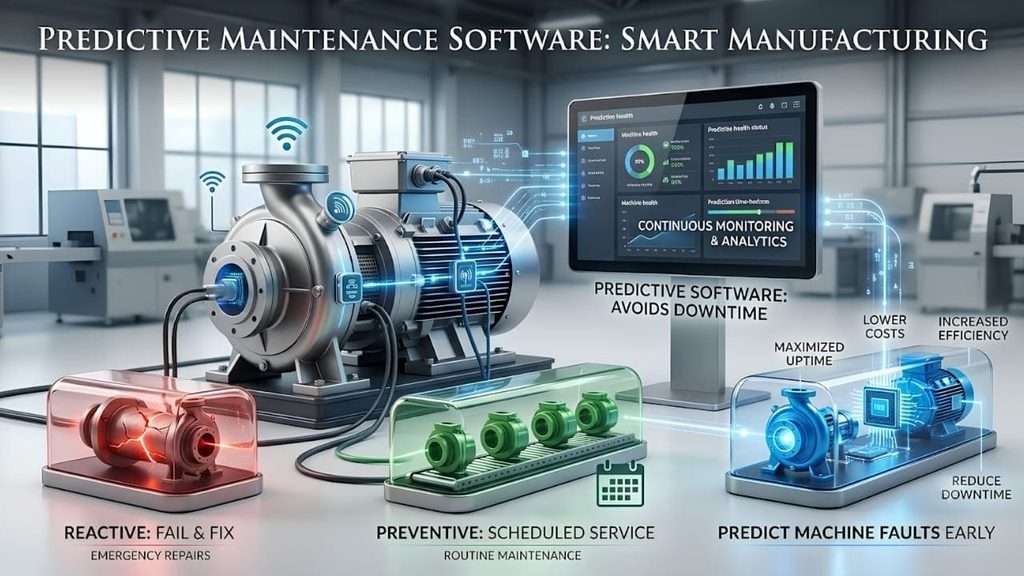
Predictive maintenance software is an Industrial IoT solution that continuously monitors machine health, analyzes sensor data, and predicts equipment failures before they cause unplanned downtime. Instead of waiting for a breakdown or following fixed maintenance schedules, manufacturers can repair equipment only when data indicates a potential issue.
For example, if a motor shows increasing vibration and temperature, the software alerts the maintenance team before the bearing fails. This prevents costly production interruptions and extends asset life. According to McKinsey & Company, predictive maintenance can reduce unplanned downtime by 30–50% and lower maintenance costs by 10–40%.
Why manufacturers are adopting intelligent maintenance
- Detect machine faults early with real-time monitoring
- Reduce unexpected equipment breakdowns
- Improve asset health and equipment reliability
- Increase Overall Equipment Effectiveness (OEE)
- Optimize maintenance planning and spare parts usage
Example comparison
| Maintenance Type | How It Works | Best For |
| Reactive | Repair after failure | Emergency fixes |
| Preventive | Service on a fixed schedule | Routine maintenance |
| Predictive | Monitor live machine data and predict failures | Maximum uptime & efficiency |
How Predictive Maintenance Software Works
The system collects live data from industrial machines, analyzes equipment behavior, and alerts maintenance teams before a failure occurs. Instead of relying on manual inspections, it gives you real-time visibility into every critical asset.
How the process works
- Collect data: IoT sensors measure vibration, temperature, current, pressure, and energy consumption.
- Analyze trends: AI detects unusual patterns and identifies early signs of wear or malfunction.
- Send instant alerts: The software notifies maintenance teams through dashboards, email, or mobile apps.
- Schedule maintenance: Teams repair the machine before it causes unplanned downtime.
Real-world example
Imagine a production motor operating 24/7. The software notices a steady increase in vibration over several days. Rather than waiting for the motor to fail, it generates an alert, allowing engineers to replace the bearing during planned maintenance. This reduces machine downtime, protects production output, and improves overall equipment reliability.
Key Features Every Predictive Maintenance Software Should Include
The right solution should do more than detect faults—it should help manufacturers monitor assets, reduce downtime, and make faster maintenance decisions from one platform.
Essential features to look for
- Asset Health Monitoring: Track the health score of motors, pumps, compressors, and other critical equipment in real time.
- Machine Downtime Monitoring: Automatically record downtime events and identify the root cause of production losses.
- Equipment Condition Monitoring: Continuously monitor vibration, temperature, current, and pressure using IoT sensors.
- AI-Based Failure Alerts: Receive early warnings when the software detects abnormal machine behavior.
- OEE Monitoring Dashboard: View availability, performance, and quality metrics alongside maintenance data.
Benefits of Predictive Maintenance Software for Manufacturing
This intelligent maintenance approach helps manufacturers prevent unexpected breakdowns, improve equipment reliability, and reduce maintenance expenses. By analyzing real-time machine data, teams can fix problems before they impact production.
Key benefits
- Reduce unplanned downtime: Detect faults early and keep production lines running smoothly.
- Lower maintenance costs: Repair components only when needed instead of following unnecessary service schedules.
- Improve asset health: Monitor critical equipment continuously and extend machine lifespan.
- Increase OEE: Boost equipment availability, performance, and production efficiency.
- Enhance worker safety: Identify overheating or abnormal vibration before equipment becomes hazardous.
Industries That Benefit Most from Industrial IoT Monitoring
Many industries rely on continuous machine operation, making predictive maintenance software essential for improving reliability and reducing unexpected downtime. Real-time monitoring helps businesses protect critical equipment and maintain consistent production.
Industries using predictive maintenance
- Steel Manufacturing: Monitor furnaces, rolling mills, and cooling systems to prevent costly production interruptions.
- Automotive: Track robotic arms, conveyors, and CNC machines for higher production efficiency.
- Food & Beverage: Monitor refrigeration units, packaging machines, and compressors to avoid product spoilage.
- Textile: Detect motor and spindle issues before they reduce fabric quality or slow production.
- Cement & Mining: Monitor crushers, pumps, and heavy rotating equipment operating in harsh environments.
Predictive Maintenance Software vs CMMS
Many manufacturers confuse Predictive Maintenance Software with a Computerized Maintenance Management System (CMMS), but they serve different purposes. A CMMS helps organize maintenance activities, while predictive maintenance software prevents failures by analyzing real-time machine data.
Key differences
| Feature | Predictive Maintenance Software | CMMS |
| Primary purpose | Predict equipment failures | Manage maintenance tasks |
| Data source | IoT sensors & live machine data | Manual records & work orders |
| AI analytics | Yes | Limited or no |
| Real-time alerts | Yes | Usually no |
| Downtime prevention | Proactive | Reactive or scheduled |
How to Choose the Right Predictive Maintenance Software
Choosing the right predictive maintenance software depends on your equipment, production goals, and Industrial IoT readiness. The best solution should provide real-time visibility, accurate failure prediction, and easy integration with existing machines. According to McKinsey & Company, predictive maintenance can reduce unplanned downtime by 30–50%, so selecting the right platform directly impacts productivity and maintenance costs.
Must-have features
- Real-time asset health monitoring
- IoT sensor connectivity
- AI-based failure alerts
- Machine downtime monitoring dashboard
- OEE and production analytics
- Cloud and mobile access
Software evaluation checklist
| Criteria | Why It Matters |
| IoT Compatibility | Connects with existing industrial sensors |
| AI Analytics | Detects anomalies before failures occur |
| OEE Integration | Measures availability, performance, and quality |
| Scalability | Supports multiple plants and assets |
| Custom Dashboards | Displays KPIs relevant to your operations |
Why Choose Niraltek Predictive Maintenance Solution?
Niraltek combines Industrial IoT, real-time monitoring, and intelligent analytics to help manufacturers monitor critical equipment from a single, easy-to-use platform. Our solution focuses on preventing machine failures, improving asset visibility, and supporting smarter maintenance decisions across industrial operations.
What makes Niraltek different?
- Real-time asset health monitoring for motors, pumps, compressors, and production equipment
- IoT sensor integration to capture vibration, temperature, current, and energy data
- Machine downtime monitoring with instant alerts for abnormal equipment behavior
- OEE-ready dashboards that provide clear insights into equipment performance and availability
- Scalable architecture suitable for single plants or multi-site manufacturing operations
Unplanned downtime doesn’t have to disrupt your production. Niraltek’s Predictive Maintenance Software helps you monitor asset health, detect equipment issues early, and improve OEE with real-time Industrial IoT analytics.
Conclusion
In today’s competitive manufacturing environment, preventing equipment failures is more valuable than simply reacting to them. This technology empowers businesses to monitor asset health, reduce machine downtime, improve OEE, and make smarter maintenance decisions using real-time Industrial IoT data. By identifying potential issues before they become costly breakdowns, manufacturers can increase productivity, extend equipment lifespan, and lower maintenance expenses.
Whether you operate a steel plant, automotive facility, or process manufacturing unit, adopting predictive maintenance is a strategic step toward building a more reliable and efficient operation. Investing in the right solution today means fewer disruptions, better operational visibility, and stronger long-term business performance.
Ready to transform your maintenance strategy? Explore Niraltek’s Predictive Maintenance Software and discover how Industrial IoT can help you keep your critical equipment running at peak performance.
Frequently Asked Questions
What is predictive maintenance and how does it work?
Predictive maintenance uses IoT sensors and AI to monitor machine performance in real time. It detects abnormal patterns such as rising vibration or temperature and alerts maintenance teams before a breakdown occurs.
What types of equipment can be monitored?
Most industrial assets can be monitored, including motors, pumps, compressors, conveyors, HVAC systems, furnaces, CNC machines, and other rotating equipment used in manufacturing.
How is predictive maintenance different from preventive maintenance?
Preventive maintenance follows a fixed service schedule, while predictive maintenance relies on live equipment data. This allows manufacturers to perform maintenance only when machine conditions indicate it is necessary.
Can predictive maintenance reduce machine downtime?
Yes. Early fault detection helps maintenance teams fix issues during planned shutdowns, reducing unexpected breakdowns and minimizing production losses.
Is predictive maintenance suitable for small and medium manufacturers?
Absolutely. Modern Industrial IoT solutions are scalable, making them suitable for both single production lines and large multi-plant manufacturing facilities.
What data is used to predict equipment failure?
The system analyzes machine parameters such as vibration, temperature, current, pressure, energy consumption, and operating hours to identify early signs of equipment deterioration.
Does predictive maintenance improve Overall Equipment Effectiveness (OEE)?
Yes. By reducing downtime and improving equipment reliability, predictive maintenance increases equipment availability and supports better overall production performance.
What should I look for when choosing a predictive maintenance solution?
Look for real-time monitoring, IoT sensor compatibility, AI-based alerts, customizable dashboards, cloud access, and easy integration with your existing industrial equipment.