

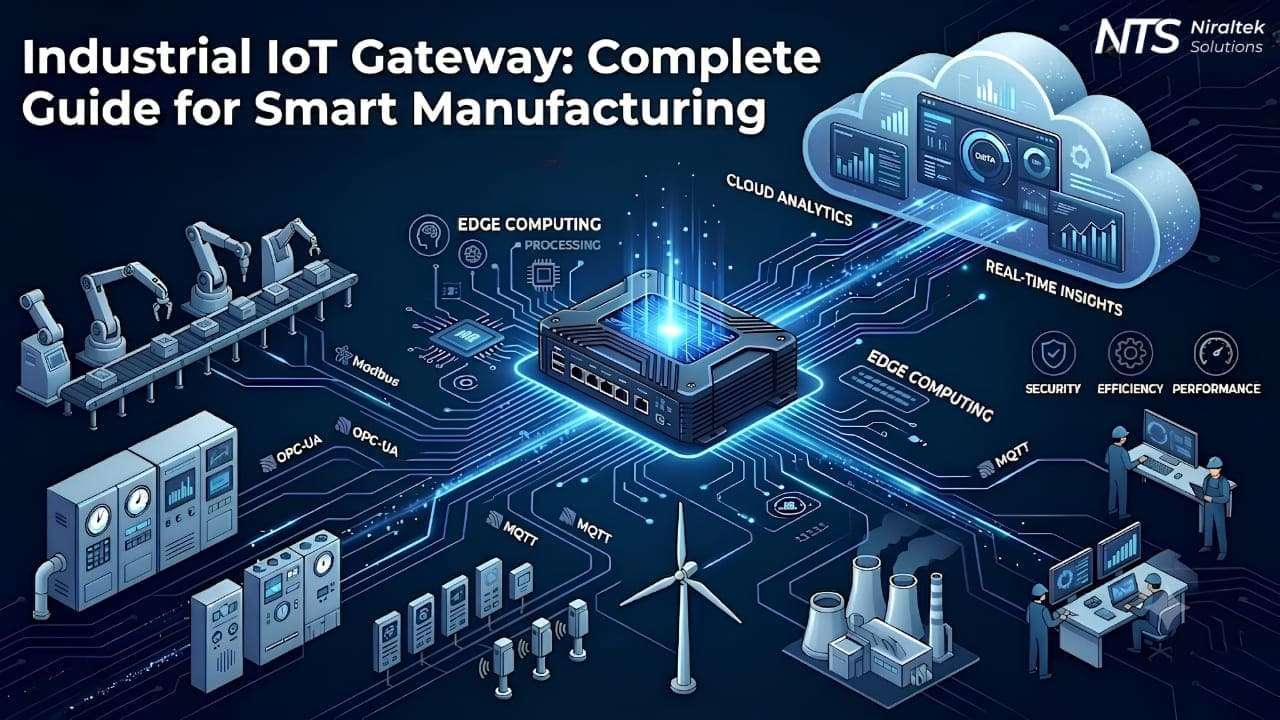
Industrial environments generate massive amounts of operational data from machines, PLCs, sensors, and industrial equipment. An Industrial IoT Gateway connects these devices with cloud platforms, enabling real-time monitoring, edge computing, and seamless communication between different industrial protocols.
Without an IIoT gateway, businesses often face data silos, delayed decision-making, and limited visibility into machine performance. As industries move toward smart manufacturing and Industry 4.0, these gateways have become essential for building connected, efficient, and scalable industrial operations.
The gateway acts as the bridge between industrial devices and cloud systems, collecting, processing, and transmitting data in real time to support faster and smarter operational decisions.
Key challenges industries face:
- Incompatible communication protocols between devices
- Lack of real-time data visibility
- High latency in data transmission
- Limited integration with cloud platforms
By solving these issues, IoT gateways enable faster decisions, improved efficiency, and smarter industrial automation.
What is an Industrial IoT Gateway?
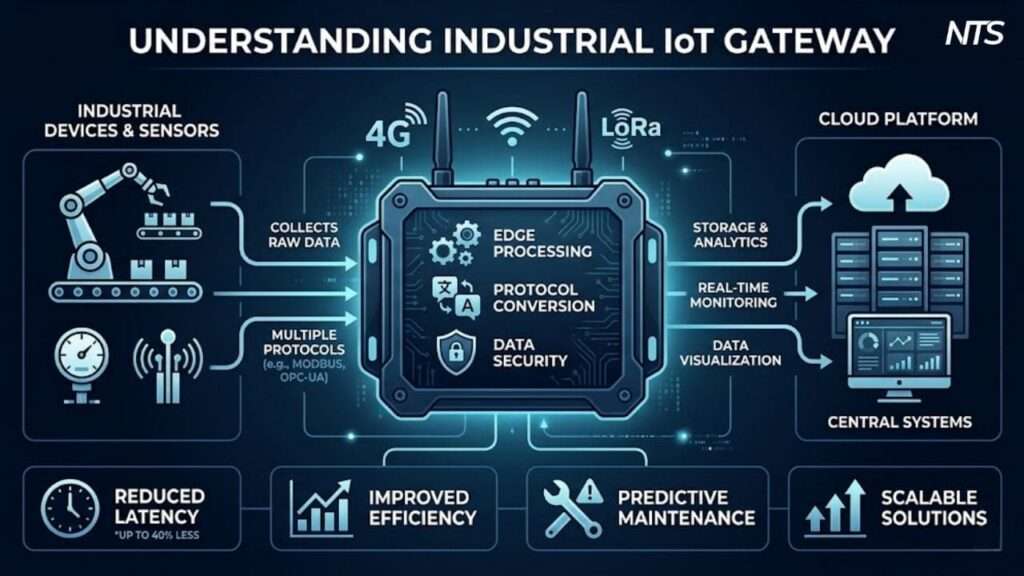
It is a hardware and software solution that connects industrial devices, sensors, and machines to cloud platforms or centralized systems. It acts as a bridge, enabling seamless communication between different protocols and systems. Instead of sending raw data directly to the cloud, the gateway processes and filters data at the edge, reducing latency and improving efficiency.
In simple terms, it collects data from machines, converts it into a usable format, and sends it to analytics platforms for real-time monitoring and decision-making.
Key Functions of an Industrial IoT Gateway
- Collects data from sensors, PLCs, and industrial equipment
- Converts protocols (Modbus, OPC-UA, MQTT, etc.)
- Processes data at the edge to reduce latency
- Ensures secure data transmission to the cloud
- Enables real-time monitoring and control
Example
A manufacturing plant uses an IoT gateway to connect legacy machines with modern cloud systems. The gateway collects machine data, processes it locally, and sends alerts when performance drops, helping reduce downtime.
Components and Their Roles
| Component | Function |
| Sensors & Devices | Collect raw industrial data |
| IoT Gateway | Processes and converts data |
| Connectivity Module | Enables communication (WiFi, GSM, LoRa) |
| Cloud Platform | Stores and analyzes data |
According to industry insights, edge-enabled IoT gateways can reduce data latency by up to 40%, enabling faster and smarter industrial decisions.
Industrial IoT Gateway Architecture
The Gateway acts as the central communication layer between industrial machines and cloud platforms. It collects data from PLCs, sensors, energy meters, and other industrial equipment, processes that data at the edge, and securely transmits only the most relevant information to cloud applications.
This architecture enables real-time monitoring, reduces network latency, improves data security, and allows legacy industrial devices to communicate with modern IIoT platforms.
How the Gateway Works
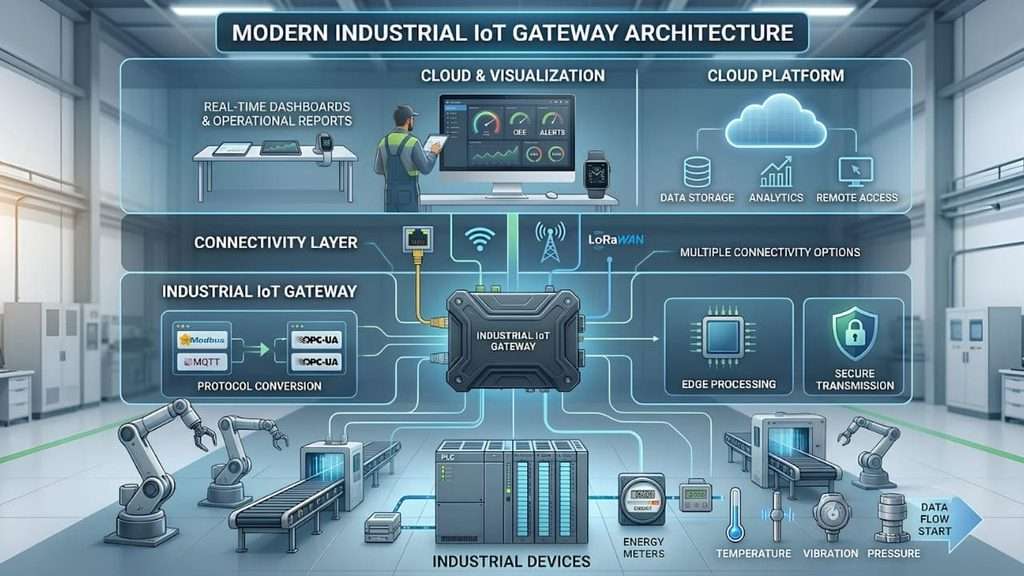
The architecture follows a simple but powerful data flow:
- Industrial Devices – Sensors, PLCs, machines, and energy meters continuously generate operational data.
- Industrial IoT Gateway – The gateway collects this data, converts industrial protocols such as Modbus, MQTT, and OPC-UA, and performs edge processing.
- Cloud Platform – Processed data is securely transmitted to the cloud for storage, analytics, and visualization.
- Dashboard & Alerts – Operators receive real-time dashboards, reports, and instant alerts for faster decision-making.
Key Components of the Architecture
| Component | Purpose |
|---|---|
| Sensors & PLCs | Capture machine and process data |
| Industrial IoT Gateway | Protocol conversion, edge processing, and secure communication |
| Connectivity Layer | Ethernet, WiFi, GSM, or LoRaWAN data transmission |
| Cloud Platform | Data storage, analytics, and remote access |
| Dashboard | Real-time monitoring, reporting, and alerts |
Key Features of an Industrial IoT Gateway
An IoT Gateway provides essential capabilities that help industries connect devices, process data, and make faster decisions. Instead of acting as a simple data transmitter, it adds intelligence at the edge and improves overall system efficiency.
Core Features
- Protocol Conversion
It connects devices that use different communication protocols such as Modbus, OPC-UA, and MQTT. - Edge Data Processing
It processes data locally before sending it to the cloud.
This reduces latency and minimizes bandwidth usage. - Real-Time Monitoring
You can track machine performance and system status instantly. - Multi-Connectivity Support
It supports WiFi, Ethernet, GSM, and LoRaWAN for flexible communication across environments. - Secure Data Transmission
It protects data using encryption and authentication mechanisms. - Remote Device Management
You can monitor and control devices from anywhere.
These features make an IIoT gateway a powerful solution for building connected, efficient, and scalable industrial systems.
Benefits of Using an Industrial IoT Gateway
This solution acts like a smart bridge between machines on the factory floor and cloud-based systems. It doesn’t just pass data-it makes your entire operation faster, smarter, and more secure.
Here’s how it adds real value:
- Real-Time Data Processing
IIoT gateways process data instantly at the edge. For example, in a manufacturing plant, the gateway can detect a machine overheating and trigger an alert immediately no need to wait for cloud processing. - Reduced Bandwidth Costs
Instead of sending all raw data to the cloud, the gateway filters and sends only relevant information. This reduces internet usage and lowers operational costs. - Improved Security
Gateways add a protective layer between devices and the internet. They encrypt data and block unauthorized access, which is crucial for industries handling sensitive information. - Protocol Conversion
Industrial environments use different communication protocols (like Modbus, OPC-UA). A gateway translates these into a common format, allowing older machines to work seamlessly with modern systems. - Enhanced Reliability
Even if internet connectivity drops, the gateway continues to collect and process data locally. For instance, a power plant can keep monitoring systems running without interruption. - Better Decision-Making
By delivering clean, structured data to analytics platforms, gateways help managers make faster and more accurate decisions-like optimizing energy usage or predicting equipment failure.
In short, an IIoT gateway doesn’t just connect devices-it unlocks efficiency, saves costs, and improves overall operational control.
Industrial IoT Gateway vs Traditional Systems
When you compare an IoT (IIoT) gateway with traditional systems, the difference is like upgrading from a basic phone to a smartphone. Traditional setups focus on isolated operations, while IIoT gateways connect, analyze, and optimize everything in real time.
Here’s a clear breakdown:
Traditional Systems
- Limited Connectivity – Machines operate in silos with little or no communication between devices
- Manual Data Handling – Teams collect and analyze data manually, which slows decisions
- Delayed Insights – Reports come after hours or days, not instantly
- Higher Downtime Risk – No predictive alerts, so failures happen unexpectedly
Industrial IoT Gateway
- Real-Time Connectivity – Connects multiple devices, sensors, and systems seamlessly
- Edge Processing – Processes data locally before sending it, reducing latency
- Smart Decision-Making – Enables predictive maintenance and automation
- Enhanced Security – Filters and encrypts data before transmission
Key Difference in Action
Imagine a power plant:
- Traditional system → Operator checks readings every few hours
- IIoT gateway → System alerts instantly when values cross safe limits
In short, traditional systems react after problems occur, while IIoT gateways help you prevent them. That shift from reactive to proactive operations is what makes IIoT a game-changer for modern industries.
Industrial Use Cases of IIoT Gateways
IIoT gateways bring real value when industries need faster decisions, better visibility, and smarter automation. They act as the bridge between machines and cloud systems, helping businesses turn raw data into useful insights.
Here are some common and practical use cases:
Smart Manufacturing
- Connect machines, PLCs, and sensors into one system
- Track production performance in real time
- Reduce delays by identifying issues instantly
Predictive Maintenance
- Monitor machine health using live data
- Identify patterns that signal wear and tear
- Schedule maintenance before breakdowns
Example: A pump shows rising temperature → gateway flags it → team fixes it before failure
Energy Monitoring & Optimization
- Track energy usage across machines and departments
- Identify energy waste and reduce costs
- Automate energy-saving actions
Remote Monitoring
- Access real-time data from anywhere
- Control equipment without being on-site
- Improve response time during emergencies
Industrial Automation
- Enable machines to communicate and act instantly
- Automate repetitive tasks and improve efficiency
- Reduce human error in operation
Final Thought
Without IIoT gateways, teams rely on manual checks and delayed reports. With them, industries gain real-time control, reduce downtime, and make faster, smarter decisions every day.
Role of Edge Computing in IoT Gateways
Edge computing plays a critical role in modern industrial systems by processing data closer to the source instead of sending everything to the cloud. This approach improves speed, reduces latency, and enables faster decision-making across operations.
Why Edge Computing Matters
Faster Data Processing
The gateway processes data locally, which reduces delays and improves response time.
Reduced Bandwidth Usage
Only relevant data gets sent to the cloud.
- Filters unnecessary data
- Optimizes network usage
Real-Time Decision Making
You can respond instantly to system changes.
Example: A machine triggers an alert immediately when performance drops.
Improved Reliability
Systems continue to operate even if cloud connectivity fails.
Enhanced Data Security
Sensitive data stays closer to the source, reducing exposure to cyber threats.
By using edge computing, IoT gateways move from simple data transmission to intelligent, real-time control, making industrial operations faster, smarter, and more efficient.
How to Choose the Right Industrial IoT Gateway
Choosing the right industrial gateway system plays a key role in ensuring reliable connectivity, efficient data processing, and long-term scalability. You need a solution that matches your industrial environment and supports future growth.
Key Factors to Consider
- Protocol Compatibility
Choose a gateway that supports multiple industrial protocols such as Modbus, OPC-UA, and MQTT. - Connectivity Options
Look for gateways that support WiFi, Ethernet, GSM, or LoRaWAN. - Edge Processing Capabilities
Select a gateway that processes data locally to reduce latency. - Security Features
Ensure the gateway offers encryption, authentication, and secure data transmission. - Scalability
Choose a solution that can grow with your operations. - Integration with Platforms
Make sure the gateway connects with your cloud or IIoT platform.
Future Trends in Industrial IoT Gateway
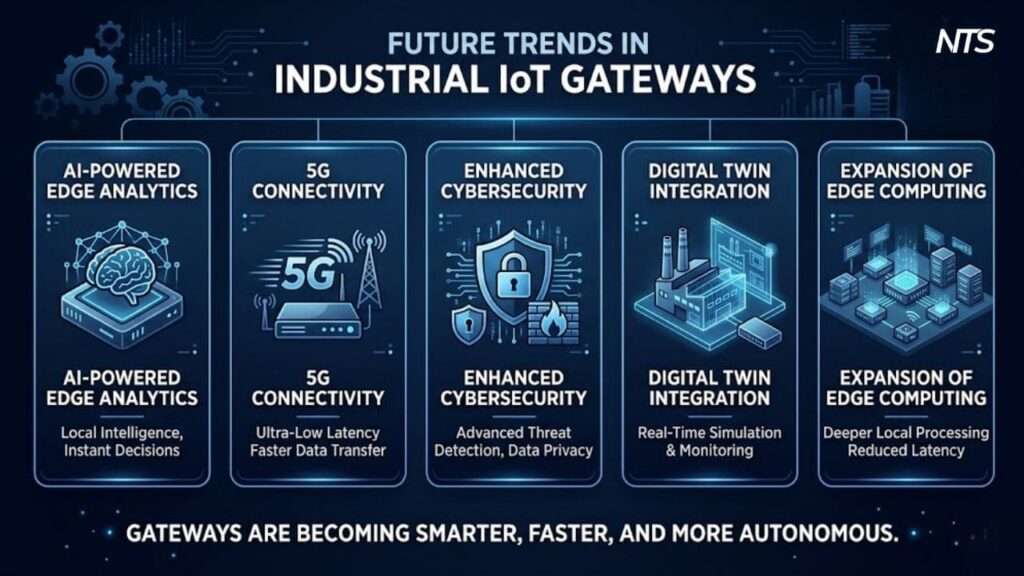
IIoT gateways continue to evolve as industries demand faster processing, smarter automation, and stronger connectivity. According to market reports, the global IIoT market is expected to grow at over 20% CAGR, driving rapid innovation in gateway technologies. These advancements will transform gateways from simple connectors into intelligent decision-making systems.
Key Emerging Trends
- AI-Powered Edge Analytics
Gateways will use AI to analyze data locally and make instant decisions. - 5G Connectivity
High-speed, low-latency networks will improve real-time communication between devices.
- Faster data transfer
- Better reliability in industrial environments
- Enhanced Cybersecurity
Future gateways will include advanced encryption and threat detection systems to protect industrial data. - Integration with Digital Twins
Gateways will support digital twin technology for real-time simulation and monitoring. - Expansion of Edge Computing
More processing will happen at the edge, reducing dependency on cloud systems.
Current vs Future Capabilities
| Feature | Current Gateways | Future Gateways |
| Processing | Basic edge processing | AI-driven analytics |
| Connectivity | WiFi, GSM | 5G-enabled |
| Security | Standard encryption | Advanced threat detection |
| Intelligence | Data transfer | Predictive & automated |
These trends show that IoT gateway will become smarter, faster, and more autonomous, enabling industries to achieve higher efficiency and better decision-making.
Why Choose DevsBot Industrial IoT Gateway
Choosing the right gateway is not just about connectivity it’s about performance, scalability, and real-time intelligence. The DevsBot Industrial IoT Gateway delivers all of these by combining advanced hardware with a powerful IIoT platform, helping businesses move toward smarter and more efficient operations.
Key Advantages of DevsBot
- Multi-Protocol Support
DevsBot connects devices using protocols like Modbus, MQTT, and OPC-UA. - Real-Time Monitoring & Control
You can track machine performance and system data instantly. - Edge Computing Capabilities
DevsBot processes data locally, reducing latency and improving response time. - Flexible Connectivity Options
It supports WiFi, Ethernet, GSM, and LoRaWAN for seamless communication across environments.
- Secure Data Transmission
It ensures data protection through encryption and secure protocols. - Scalable IIoT Platform Integration
You can easily expand your system as your business grows.
By choosing DevsBot Industrial IoT Gateway, businesses gain a reliable, scalable, and intelligent solution that turns industrial data into actionable insights and measurable results.
Turn your industrial data into actionable insights with Niraltek’s smart IoT gateway platform—built for performance, reliability, and growth.
Real-World Industrial IoT Gateway Implementation
At Niraltek Solutions, our Industrial IoT Gateway is used in manufacturing and energy monitoring projects to connect legacy PLCs, electrical meters, and industrial sensors with cloud dashboards. This enables real-time visibility, remote monitoring, and data-driven operational decisions without replacing existing equipment.
Conclusion
An IoT gateway is no longer just a connectivity tool-it has become a critical component for modern industrial transformation. By enabling real-time data collection, edge processing, and secure communication, it helps businesses move from manual operations to intelligent, data-driven decision-making.
From manufacturing plants to smart infrastructure, industries that adopt IoT gateways gain better visibility, reduced downtime, and improved operational efficiency. As technologies like AI, edge computing, and 5G continue to evolve, IoT gateways will play an even bigger role in building smarter and more connected industrial ecosystems.
Ready to take your industrial operations to the next level? Discover how Niraltek can help you implement powerful Industrial IoT Gateway solutions for real-time insights, efficiency, and scalable growth.
FAQs
1. What is an Industrial IoT Gateway?
An IoT Gateway is a device that connects industrial machines and sensors to cloud platforms, enabling real-time data collection, processing, and communication.
2. How does an Industrial IoT Gateway work?
It collects data from devices, converts different protocols, processes data at the edge, and sends relevant information to the cloud for monitoring and analysis.
3. What are the benefits of using an Industrial IoT Gateway?
Businesses can improve efficiency, reduce downtime, enable real-time monitoring, enhance security, and lower operational costs.
4. What protocols do IoT gateways support?
Industrial IoT Gateways support protocols such as Modbus, OPC-UA, MQTT, and HTTP, allowing seamless communication between different devices.
5. How is an IoT gateway different from a router?
A router only transfers data between networks, while an IIoT gateway processes, filters, and secures data before sending it to the cloud.
6. Which industries use Industrial IoT Gateways?
Manufacturing, energy, logistics, smart buildings, and infrastructure sectors widely use IoT gateways for monitoring and automation.
7. What is the role of edge computing in IoT gateways?
Edge computing allows gateways to process data locally, enabling faster decision-making and reducing dependency on cloud systems.
8. How to choose the right Industrial IoT Gateway?
Consider factors like protocol support, connectivity options, security features, scalability, and integration with your IIoT platform.