

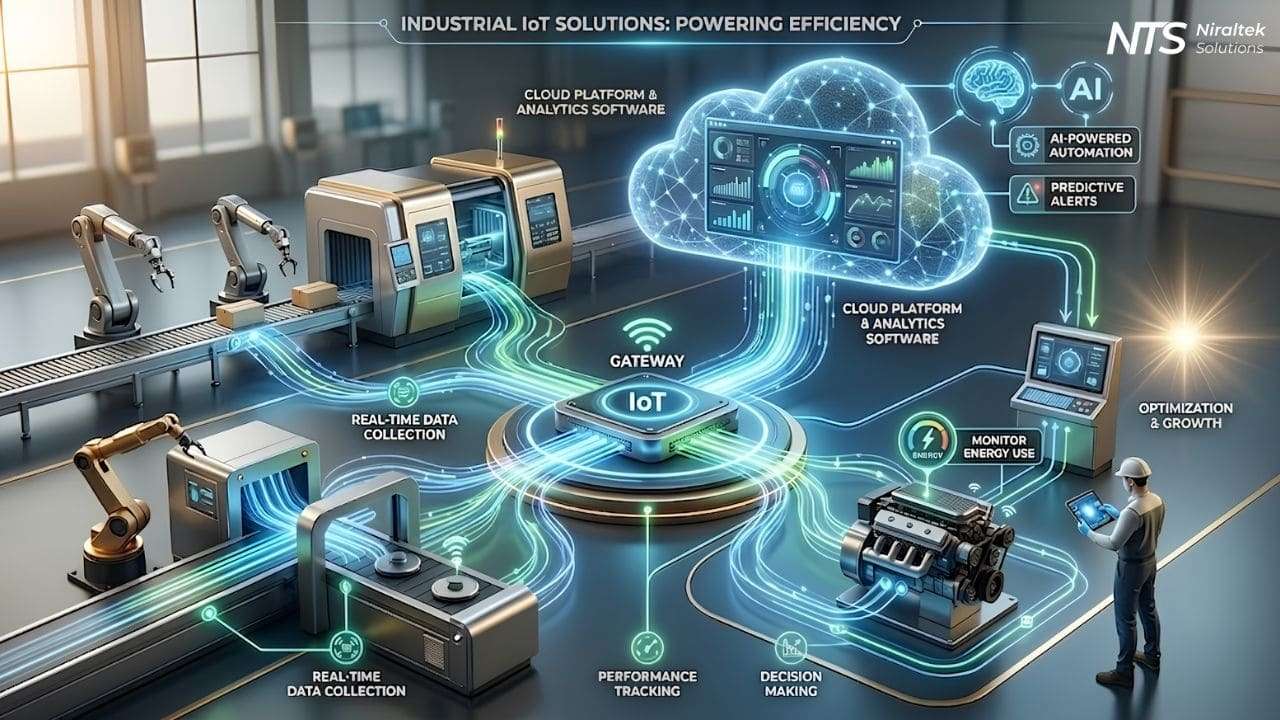
Industries today face rising energy costs, unplanned downtime, and inefficient operations due to lack of real-time visibility. Studies show that Industrial IoT can improve operational efficiency by up to 25% and reduce maintenance costs by 30% (McKinsey). This is where IoT Solutions play a critical role by connecting machines, data, and systems for smarter decision-making.
Key challenges solved by Industrial IoT:
- Lack of real-time energy monitoring
- High operational and maintenance costs
- Inefficient automation systems
By leveraging smart energy monitoring and AI-driven automation, Industrial IoT transforms traditional industries into intelligent, data-driven ecosystems.
What Are Industrial IoT Solutions?
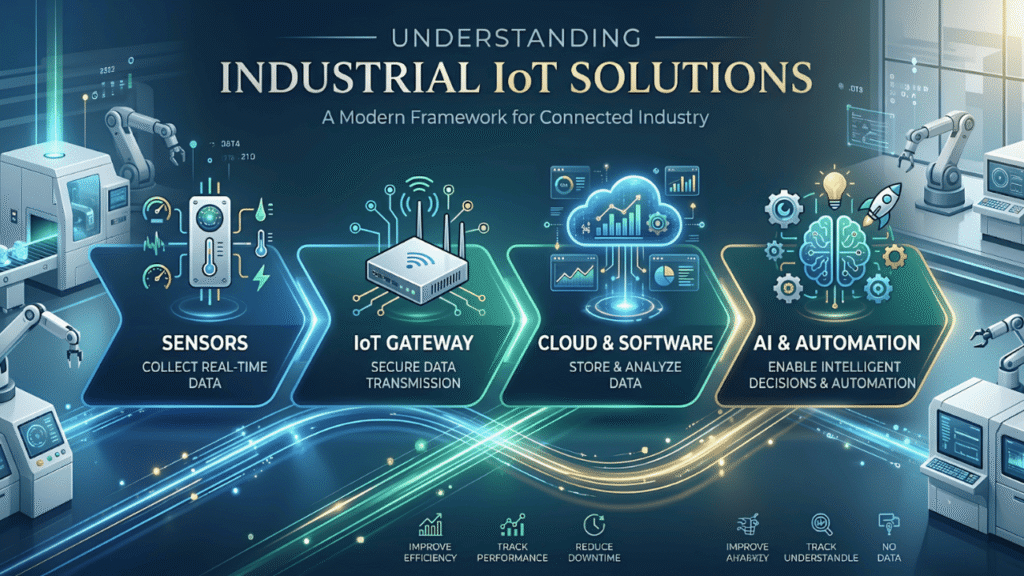
Industrial IoT Solutions connect machines, sensors, and software to collect and analyze real-time data, helping industries make faster and smarter decisions. Instead of relying on manual monitoring, businesses use IoT systems to automate operations and improve efficiency. According to Deloitte, companies using Industrial IoT can increase productivity by up to 20%.
Key components of Industrial IoT Solutions:
- Smart sensors to collect machine and energy data
- IoT gateway hardware to transmit data securely
- Cloud platforms for storage and analysis
- AI automation tools for decision-making
| Component | Function | Example |
| Sensors | Collect real-time data | Temperature, energy meters |
| IoT Gateway | Transfers data to cloud | Industrial IoT gateway device |
| Software Platform | Analyzes and visualizes data | Energy management software |
| AI Automation | Automates actions | Predictive maintenance alerts |
For example, a manufacturing plant can use IoT sensors to track energy usage and reduce waste instantly.
Leading technology providers like IBM highlight the importance of IoT in enabling smarter industrial operations.
Role of Industrial IoT in Energy Management & Automation
IoT systems play a crucial role in improving energy efficiency and automating industrial operations. Instead of relying on manual processes, businesses use connected devices to monitor, analyze, and control systems in real time.
In energy management, IoT helps companies track electricity consumption and reduce waste. For example, a factory can use smart meters to identify high energy usage and optimize operations instantly.
In automation, IoT enables machines to communicate and perform tasks without human intervention. This improves productivity and reduces downtime.
Key roles of Industrial IoT in energy and automation:
- Monitor real-time energy usage with smart energy monitoring systems
- Optimize operations using IoT energy management systems
- Automate machines with AI automation solutions
- Reduce costs through predictive maintenance
- Improve decision-making with real-time data
Key Benefits of Industrial IoT Solutions
These connected systems help businesses improve efficiency, reduce costs, and gain real-time control over operations. Instead of reacting to problems, companies can predict and prevent them using connected systems.
Key benefits of IoT systems:
- Reduced energy consumption: Smart energy monitoring systems track usage and help eliminate waste. For example, a factory can reduce electricity costs by identifying high-consumption machines.
- Improved operational efficiency: Real-time data helps teams make faster decisions and optimize workflows.
- Predictive maintenance: Sensors detect issues early, preventing unexpected machine breakdowns.
- Cost savings: Automation reduces manual work and lowers maintenance expenses.
- Enhanced productivity: Automated systems run continuously with minimal downtime.
Custom IoT Solutions for Different Industries
Custom IoT solutions help businesses solve industry-specific challenges by delivering tailored systems instead of one-size-fits-all platforms. Companies design these solutions based on operational needs, improving efficiency, automation, and energy management.
Manufacturing Industry
Manufacturers use IoT sensors and automation systems to monitor machines and reduce downtime. For example, a factory can detect equipment issues early and schedule maintenance before failure.
Energy Sector
Energy companies rely on smart energy monitoring systems to track consumption and optimize usage. This helps reduce energy waste and lower operational costs.
Warehousing & Cold Storage
Warehouses use IoT solutions to monitor temperature, humidity, and energy usage in real time. For example, cold storage units can maintain ideal conditions automatically.
Key advantages of custom IoT solutions:
- Tailored to specific business needs
- Improve operational efficiency
- Enable real-time monitoring
- Support scalable growth
Custom IoT solutions give industries better control, smarter automation, and improved decision-making.
How to Choose the Best Industrial IoT Solution
Choosing the best Industrial IoT solution requires a clear focus on your business needs and operational goals. Instead of selecting a generic system, you should look for a solution that improves efficiency and supports long-term growth.
Identify Your Business Needs
Start by understanding your requirements. For example, a manufacturing unit may need machine monitoring, while an energy company may focus on smart energy monitoring systems.
Check Integration and Compatibility
Choose a solution that connects easily with your existing machines and software. For example, your IoT platform should work smoothly with your energy management software.
Evaluate Scalability and Flexibility
Select a system that can grow with your business. A scalable solution allows you to add more devices and features without major changes.
Key Factors to Consider
- Real-time data and analytics
- Strong security and data protection
- Custom IoT solutions for your industry
- Reliable support and maintenance
By focusing on these factors, you can choose an Industrial IoT solution that delivers better performance, cost savings, and smarter automation.
Challenges in Implementing Industrial IoT
Implementing Industrial IoT solutions offers many benefits, but businesses often face practical challenges during adoption. Companies need proper planning and strategy to overcome these issues and ensure smooth implementation.
Key challenges include:
- High initial investment: Setting up sensors, IoT gateway hardware, and software platforms requires significant upfront cost.
- Integration with existing systems: Many industries use legacy equipment that does not easily connect with modern IoT solutions.
- Data security concerns: Connected devices increase the risk of cyberattacks, so businesses must secure sensitive data.
- Complex data management: IoT systems generate large volumes of data, making it difficult to analyze and use effectively.
- Skill gap: Companies often lack trained professionals to manage IoT systems.
Future of Industrial IoT in Energy & Automation
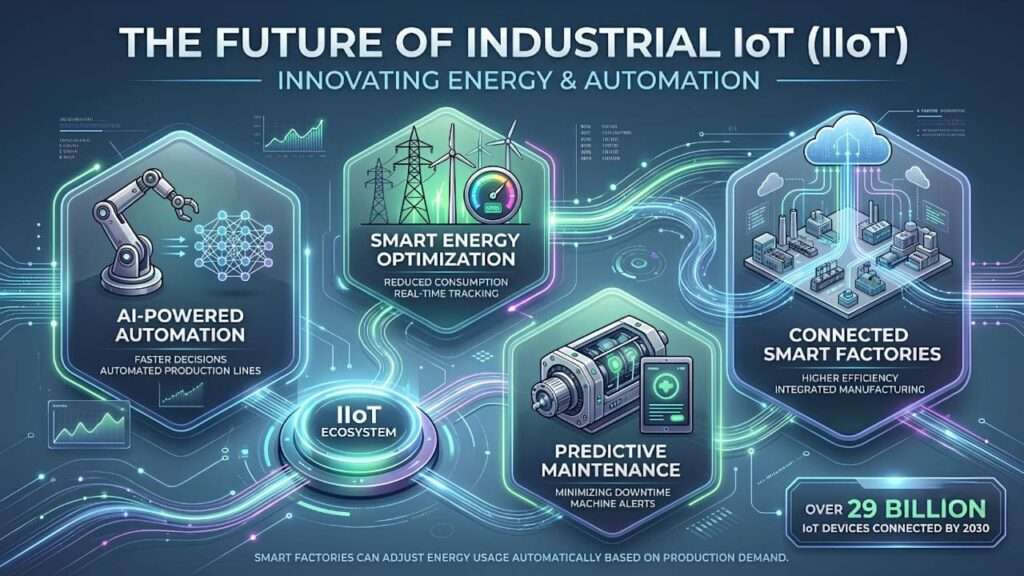
Industrial IoT continues to transform energy and automation with smarter, faster, and more efficient systems. Companies now use AI-driven insights and real-time data to optimize operations and reduce costs. According to Statista, the number of IoT devices is expected to exceed 29 billion by 2030, showing massive growth in this sector.
Key future trends include:
- AI-powered automation: Systems make decisions without human intervention
- Smart energy optimization: Industries reduce energy waste using real-time monitoring
- Predictive maintenance: Machines detect failures before breakdowns
- Connected smart factories: Fully automated and data-driven operations
| Trend | Impact | Example |
| AI Automation | Faster decision-making | Automated production lines |
| Smart Energy Systems | Reduced energy consumption | Real-time energy tracking |
| Predictive Maintenance | Lower downtime | Machine failure alerts |
| Smart Factories | Increased efficiency | Fully connected manufacturing |
Ready to transform your operations with smart energy and automation? Explore advanced Industrial IoT solutions with Niraltek and take the next step toward efficient, data-driven growth.
Conclusion
These systems are transforming how industries manage energy, automate operations, and improve overall efficiency. By connecting devices, analyzing real-time data, and enabling smart decision-making, businesses can reduce costs, prevent downtime, and achieve higher productivity. From smart energy monitoring systems to AI-driven automation, Industrial IoT creates a powerful foundation for modern, data-driven industries.
As competition grows and energy demands increase, companies must adopt smarter technologies to stay ahead. Industrial IoT not only solves current operational challenges but also prepares businesses for future growth and innovation.
If you want to optimize energy usage, improve automation, and build a smarter industrial ecosystem, now is the right time to take action. Explore advanced Industrial IoT solutions with Niraltek and start transforming your operations today:
FAQs
What are Industrial IoT Solutions?
Industrial IoT solutions connect machines, sensors, and software to collect and analyze real-time data. They help industries improve efficiency, automate processes, and make smarter decisions.
How do Industrial IoT solutions improve energy management?
Industrial IoT solutions use smart energy monitoring systems to track power consumption in real time. This helps businesses reduce energy waste, optimize usage, and lower operational costs.
What industries use Industrial IoT solutions?
Industries like manufacturing, energy, logistics, warehousing, and cold storage use Industrial IoT solutions to improve automation, monitoring, and efficiency.
What is an IoT energy management system?
An IoT energy management system monitors and controls energy usage using connected devices and data analytics. It helps industries reduce energy consumption and improve sustainability.
What is IoT gateway hardware?
IoT gateway hardware acts as a bridge between devices and cloud systems. It collects data from sensors, processes it, and sends it securely for analysis.
What benefits do these technologies offer?
Industrial IoT solutions offer benefits like reduced costs, improved efficiency, predictive maintenance, real-time monitoring, and better decision-making.
How can businesses choose the right Industrial IoT solution?
Businesses should consider their requirements, scalability, integration capability, and real-time data features when selecting an Industrial IoT solution.
What is the future of Industrial IoT in industries?
The future of Industrial IoT includes AI-driven automation, smart factories, and advanced energy optimization systems that improve efficiency and sustainability.