

India’s solar sector is expanding rapidly, making reliable performance monitoring increasingly important for businesses and solar operators. According to the Ministry of New and Renewable Energy (MNRE), India had 162.15 GW of installed solar power capacity as of June 30, 2026, including ground-mounted, rooftop, hybrid, and off-grid solar.
As solar installations grow, businesses need more than panels—they need visibility into how their systems perform.
A Solar Monitoring System helps organizations:
- Track solar generation in real time
- Monitor inverter and equipment performance
- Detect faults and abnormal conditions
- Analyze historical energy data
- Improve maintenance and operational decisions
Without proper monitoring, performance issues can remain unnoticed and reduce the value of a solar investment.
What Is a Solar Monitoring System?
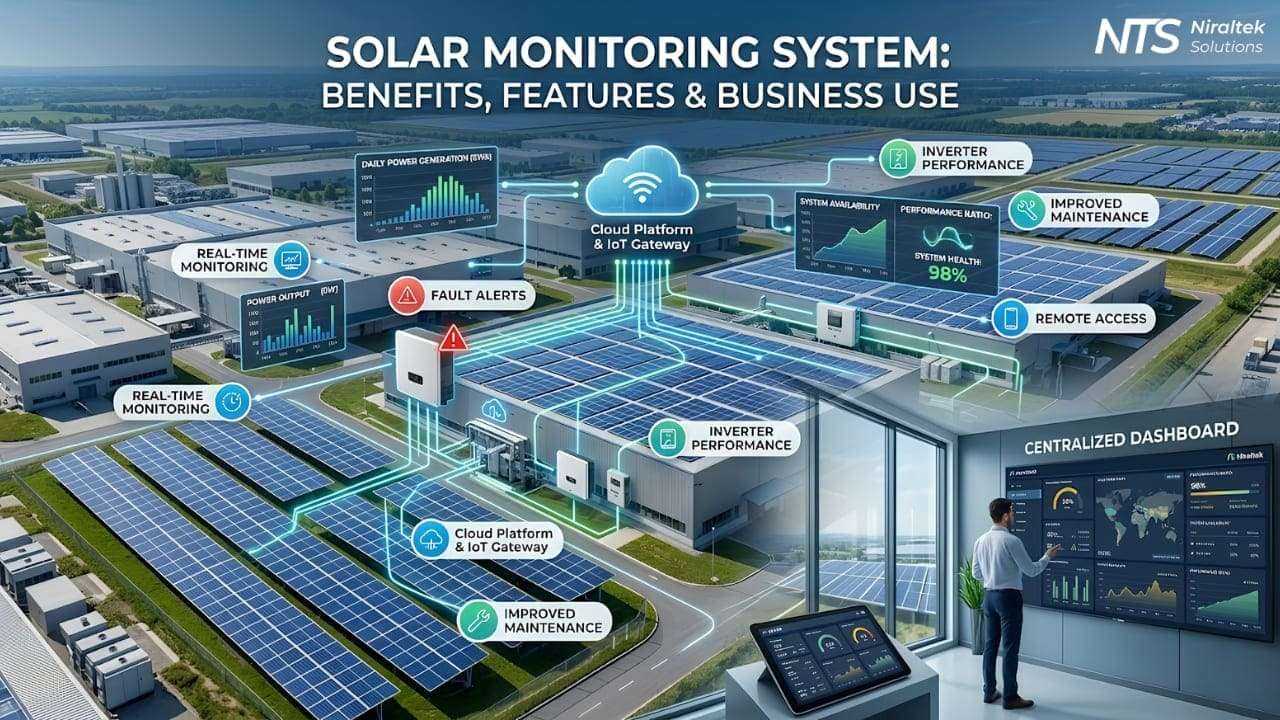
A solar monitoring system is a hardware-and-software solution that tracks how a solar installation generates and uses energy. It collects data from solar panels, inverters, meters, and sensors, then displays the information through a centralized dashboard. This helps businesses identify performance issues before they become costly problems.
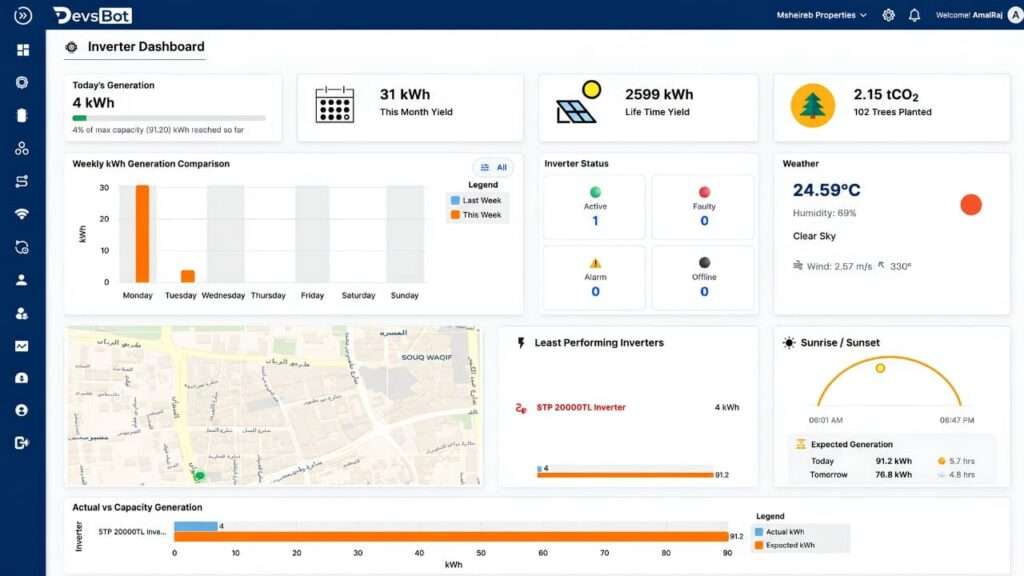
This monitoring solution can help businesses
- Track real-time solar energy generation
- Monitor inverter and equipment performance
- Detect faults and abnormal output
- Analyze historical energy trends
- Support faster maintenance decisions
| Without Monitoring | With Solar Monitoring |
| Manual checks | Real-time visibility |
| Delayed fault detection | Automated alerts |
| Limited performance data | Detailed analytics |
| Reactive maintenance | Data-driven maintenance |
How Does a Solar Energy Monitoring System Work?
A solar energy monitoring system collects data from solar panels, inverters, meters, and sensors, then turns that data into useful performance insights. NREL’s PV performance work uses production, irradiance, and temperature data to evaluate metrics such as availability, performance ratio, and energy performance.
The process typically follows these steps:
- Data collection: Sensors, meters, and inverters capture generation and equipment data.
- Data transmission: An IoT gateway sends the information to the monitoring platform.
- Data processing: The platform organizes and analyzes the incoming data.
- Dashboard visualization: Users view generation, power output, inverter status, and trends.
- Alerts: The system can flag abnormal conditions or equipment issues.
What Does a Solar PV Monitoring System Monitor?
A solar PV monitoring system tracks the electrical and environmental conditions that affect solar power generation. It gives businesses a clear view of whether their photovoltaic (PV) installation performs as expected.
Key parameters include:
- Solar energy generation: Tracks daily, monthly, and yearly electricity production.
- Power output: Shows how much power the PV system produces at a given time.
- Voltage and current: Helps teams evaluate electrical performance.
- Irradiance: Measures available sunlight and helps compare expected and actual generation.
- Temperature: Tracks module or ambient temperature, which can affect PV performance.
- Inverter performance: Shows inverter status, output, and fault conditions.
- System availability: Helps identify downtime and communication issues.
Key Features of a Solar Power Monitoring System
A solar power monitoring system gives businesses real-time visibility into solar generation and equipment performance. Modern monitoring platforms can track electrical data, analyze performance, generate reports, and alert operators when they detect abnormal conditions.
Key features include:
- Real-time monitoring: Track solar generation, voltage, current, and power output.
- Centralized dashboard: View multiple inverters, PV systems, and sites from one platform.
- Inverter monitoring: Check inverter status, performance, and fault conditions.
- Automated alerts: Receive notifications when the system detects faults or unusual output.
- Performance analytics: Compare actual generation with expected performance.
- Historical reports: Analyze daily, monthly, and long-term energy trends.
- Remote monitoring: Check solar assets without visiting the site.
What Are the Benefits of a Solar Monitoring System?
A solar monitoring system helps businesses turn solar performance data into practical maintenance and energy decisions. Instead of waiting for a monthly report or physical inspection, teams can track performance and respond to issues sooner. The U.S. Department of Energy highlights real-time monitoring as a way to identify PV performance challenges and support effective operations and maintenance.
Key benefits include:
- Detect faults early: Identify abnormal inverter or generation patterns.
- Reduce downtime: Help maintenance teams respond to problems faster.
- Improve performance: Track actual generation and spot underperformance.
- Simplify maintenance: Use performance data to prioritize inspections.
- Monitor remotely: Check solar assets without visiting the site.
- Support better decisions: Use historical reports to identify trends.
Solar Monitoring System for Industrial and Commercial Applications
Industrial and commercial facilities often operate large solar installations alongside significant electricity loads. A solar monitoring system gives facility teams real-time visibility into generation, inverter performance, faults, and energy trends. The U.S. Department of Energy notes that PV monitoring helps operators identify performance issues in real time and support effective operation and maintenance.
Common applications include:
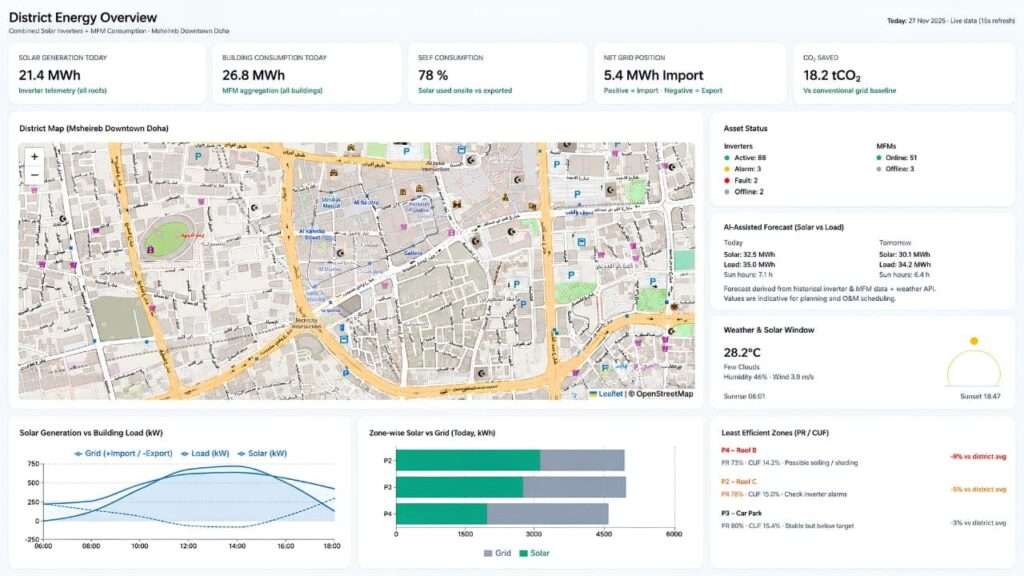
- Manufacturing plants: Track solar generation alongside factory energy consumption.
- Commercial buildings: Monitor rooftop solar performance and identify unusual output.
- Solar farms: Manage multiple inverters and PV assets from a centralized dashboard.
- Warehouses: Compare solar production with facility demand.
- Educational campuses: Monitor generation across multiple buildings or installations.
How IoT Improves Solar Monitoring Systems
IoT connects solar equipment, sensors, gateways, and cloud platforms so businesses can monitor solar assets without relying only on manual inspections. A connected system can collect electrical and environmental data, transmit it remotely, and help teams identify performance issues faster.
Key IoT benefits include:
- Real-time data collection: Capture power, voltage, current, temperature, and other parameters.
- Remote monitoring: Check solar assets from a centralized dashboard.
- Faster fault detection: Receive alerts when performance changes unexpectedly.
- Centralized analytics: Compare historical and real-time performance data.
- Scalable monitoring: Connect multiple solar sites to one platform.
| Traditional Monitoring | IoT-Based Monitoring |
| Manual checks | Continuous data collection |
| Delayed detection | Real-time alerts |
| Site visits | Remote access |
| Limited data | Centralized analytics |
Solar Monitoring System KPIs and Performance Metrics to Track
Tracking the right KPIs helps businesses understand whether a solar installation performs as expected. NREL identifies availability, performance ratio, and energy ratio as key measures for evaluating PV system performance.
A solar monitoring system can help teams track:
- Energy generation: Measure daily, monthly, and annual electricity output.
- Power output: Monitor real-time power production.
- Performance ratio: Compare actual production with expected production.
- System availability: Track how often the system remains operational.
- Inverter availability: Identify inverter downtime and performance issues.
- Energy ratio: Compare measured energy with modeled energy production.
- Downtime: Identify periods when the system stops or underperforms.
How to Choose the Right Solar Monitoring System
Choosing the right solar monitoring system starts with understanding what your business needs to monitor, how much data you need, and how your existing solar equipment connects. The U.S. Department of Energy recommends considering measurement capabilities, reporting, data access, cybersecurity, maintenance, and system continuity when selecting a PV monitoring platform.
Look for these key factors:
- Equipment compatibility: Confirm support for your inverters, meters, and sensors.
- Real-time monitoring: Check generation, power, voltage, current, and equipment status.
- Alerts: Choose configurable notifications for faults and abnormal performance.
- Data and reports: Look for historical trends and useful KPI reports.
- Remote access: Monitor multiple sites through a web or mobile dashboard.
- Scalability: Make sure the platform can support additional solar assets.
- Integration: Check compatibility with IoT, SCADA, or energy management systems.
- Security: Review data protection, access controls, and backup options.
Solar Monitoring System vs. Traditional Solar Monitoring
Traditional solar monitoring often relies on manual inspections or basic inverter displays, which can make it harder to identify performance issues quickly. A modern solar monitoring system combines real-time data collection, dashboards, analytics, and alerts to give businesses a clearer view of their solar assets. The U.S. Department of Energy recommends monitoring PV performance in real time to identify and address operational challenges.
| Traditional Monitoring | Solar Monitoring System |
| Manual checks | Real-time monitoring |
| Delayed issue detection | Automated alerts |
| Limited data | Detailed performance analytics |
| Site visits | Remote access |
| Manual reports | Automated reports |
Key advantages include:
- Faster fault detection: Identify abnormal generation or inverter issues.
- Better visibility: Track multiple assets from one dashboard.
- Simpler maintenance: Use performance data to prioritize inspections.
- Remote monitoring: Check system status without visiting the site.
Get real-time visibility into solar generation, inverter performance, faults, and key energy metrics with Niraltek’s Solar Energy Monitoring System.
Conclusion
A solar monitoring platform gives businesses real-time visibility into solar generation and equipment performance.
It helps detect faults early, reduce downtime, and support smarter maintenance decisions.
With remote monitoring and performance analytics, teams can manage solar assets more efficiently.
IoT connectivity also enables centralized monitoring across multiple solar installations.
For industrial and commercial facilities, better monitoring means better control over solar performance.
Explore Niraltek’s Solar Energy Monitoring System to monitor your solar assets smarter.
Frequently Asked Questions
1. What is a solar monitoring system?
A solar monitoring system tracks solar generation, equipment performance, power output, and system status. It collects data from connected devices and presents useful information through a dashboard, helping businesses identify performance changes and make better maintenance decisions.
2. How does solar monitoring work?
The system collects data from solar panels, inverters, meters, and sensors. An IoT gateway can transmit this information to a cloud platform, where users can view real-time performance, historical trends, and alerts through a centralized dashboard.
3. What does a solar PV monitoring system track?
A solar PV monitoring system can track energy generation, power output, voltage, current, inverter status, equipment faults, and other performance parameters. These measurements help operators understand how effectively their photovoltaic installation performs.
4. Can businesses monitor solar systems remotely?
Yes. Cloud-connected platforms allow teams to check solar performance from a computer or mobile device. This makes it easier to monitor multiple locations, review alerts, and investigate unusual performance without visiting every site.
5. What is an inverter monitoring system?
An inverter monitoring system focuses on inverter status, output, efficiency, faults, and operating conditions. It helps maintenance teams identify abnormal inverter behavior and investigate potential issues before they affect solar generation for an extended period.
6. What are the main benefits of solar monitoring?
Key benefits include real-time visibility, earlier fault detection, easier maintenance planning, remote access, performance analysis, and centralized reporting. Businesses can use this information to understand system behavior and make more informed operational decisions.
7. What is the difference between solar monitoring and renewable energy monitoring?
Solar monitoring focuses specifically on photovoltaic assets and their performance. A renewable energy monitoring system can cover a broader range of renewable assets, depending on the platform, such as solar, wind, and battery storage.
8. How can businesses choose the right monitoring solution?
Businesses should consider equipment compatibility, real-time data access, inverter support, alerts, reporting, scalability, connectivity, integrations, security, and technical support. The right solution should match the site’s equipment, monitoring requirements, and future expansion plans.